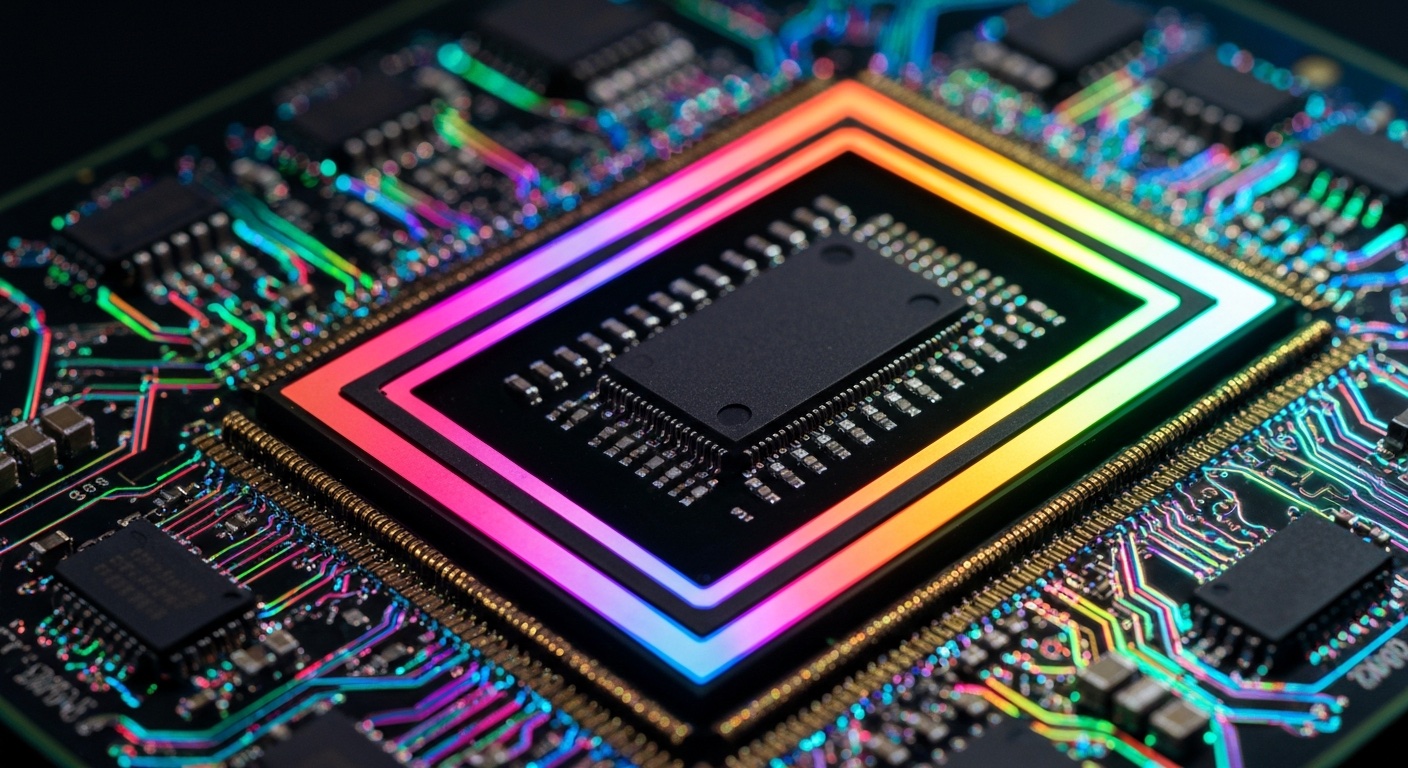
In September 2023, Huawei launched the Mate 60 Pro with a Kirin 9000s chip manufactured in 7 nanometers by SMIC—China's largest semiconductor foundry. The detail: this chip should not exist. The US had cut off Chinese access to ASML's EUV lithography machines, considered indispensable for producing chips below 7nm. China did it anyway, using simpler machines.
This episode summarizes the chip war between the US and China: Washington erects barriers, Beijing finds alternative paths. After six years of increasing sanctions, China's semiconductor industry has not only survived—it is expanding. And the consequences of this dispute reach all the way to Brazil.
Timeline of the chip war: from 2018 to today
The US-China technology war did not start with chips, but it is where it has focused. Here is the timeline:
2018 — ZTE. The US Commerce Department prohibits American companies from selling components to ZTE, alleging violation of sanctions to Iran. ZTE nearly collapses. After negotiation, it pays a fine of 1.4 billion US dollars and accepts American monitoring. The episode serves as a warning for Beijing: dependence on foreign chips is a strategic vulnerability.
2019 — Huawei on the Entity List. Washington places Huawei on the restricted entity list, cutting off the company's access to chips designed with American software and manufactured by TSMC in Taiwan. Huawei's chip design arm, HiSilicon, loses its main manufacturer. The stock of Kirin chips begins to diminish.
2020 — SMIC in the crosshairs. In September, the Commerce Department classifies SMIC as a "military end user" and requires special licenses for American suppliers. In December, the company is added to the Entity List. Access to American chip manufacturing equipment becomes severely restricted. SMIC had revenues of 3.6 billion US dollars and operated processes up to 14nm.
2022 — CHIPS Act and the October package. In August, Biden signs the CHIPS and Science Act, allocating 52 billion US dollars in subsidies for chip manufacturing in the US. On October 7th, the toughest blow comes: new export rules prohibit the sale of advanced AI chips, manufacturing equipment, and even American citizens' services to China's semiconductor industry. The stated goal: to freeze China at the technological level it was at.
2023 — ASML and the multilateral siege. In January, the US, Japan, and the Netherlands sign an agreement to restrict lithography equipment exports to China. ASML, the Dutch company that holds 83% of the global lithography machine market, is prohibited from selling its EUV machines to China. From the second half of the year, more advanced DUV machines also enter the list of restrictions. In September, Huawei surprises the world with the Mate 60 and the 7nm Kirin 9000s chip, manufactured by SMIC.
2024 — Escalation on both sides. SMIC reports revenue of 8 billion US dollars, more than doubling from 2020. The Financial Times reports that SMIC would be preparing production at 5nm. China bans Intel and AMD processors in government computers, replacing them with Loongson and Phytium chips. In September, China presents two new domestic DUV lithography machines: one at 193nm with resolution below 65nm and another at 248nm with 110nm resolution.
2025-2026 — The current state. In July 2025, the US plans to restrict shipments of AI chips to Thailand and Malaysia, attempting to close smuggling routes. In June, Taiwan adds SMIC to its own export control list. In December 2025, Reuters reveals that China has secretly completed an EUV lithography machine prototype in Shenzhen, with production of functional chips expected between 2028 and 2030. China's self-sufficiency in semiconductors, which was less than 17% in 2020, advances towards the 70% target set by the Made in China 2025 program—still distant, but the trajectory is upward.
The key players in this war
SMIC (Semiconductor Manufacturing International Corporation) is China's largest chip foundry and the world's third-largest in 2024. Founded in 2000 in Shanghai, the company jumped from 14nm to 7nm processes in just two years, using ASML's DUV lithography. Revenue grew from 3.6 billion US dollars in 2018 to 8 billion US dollars in 2024. Co-CEOs Zhao Haijun and Liang Mong Song (ex-TSMC and Samsung) lead the operation. China Integrated Circuit Industry Investment Fund and Datang Telecom are significant shareholders.
ASML is the Dutch company that manufactures the lithography machines used by all major foundries worldwide. With 28.26 billion euros in revenue in 2024, it holds 83% of the global market. Its EUV machines cost over 150 million euros each and are necessary for producing chips below 5nm efficiently. ASML has never sold EUV machines to China—the restriction existed informally before the official sanctions. The novelty is the prohibition of more advanced DUV machines.
TSMC (Taiwan Semiconductor Manufacturing Company) manufactures about 90% of the world's most advanced chips. It is the manufacturer that Huawei lost in 2020 when the US cut off access. TSMC operates at 3nm and advances to 2nm. The company is building factories in the US (Arizona) and Japan, diversifying its geographical base under pressure from Washington.
Huawei and HiSilicon—HiSilicon is Huawei's chip design arm, responsible for the Kirin line. Before the sanctions, Kirin chips were manufactured by TSMC at advanced processes. After the cut-off, Huawei spent years using stockpiled chips or buying from third parties. The 2023 Kirin 9000s, manufactured by SMIC at 7nm, marked the return of its own capacity—albeit with lower yield and higher cost than the equivalent from TSMC.
Why the sanctions are not working as planned
The logic of the sanctions was straightforward: without access to ASML's EUV machines, China would be stuck at processes above 14nm, unable to manufacture advanced chips for smartphones, AI, and high-performance computing. That is not what is happening. Three factors explain this:
1. DUV lithography works beyond expectations. DUV (deep ultraviolet) lithography machines, which use a 193nm laser, were considered insufficient for processes below 10nm. SMIC proved otherwise. Using multi-patterning techniques—exposing the wafer multiple times with different patterns—it is possible to achieve 7nm and possibly 5nm with DUV. The process is slower, more expensive, and generates more defects, but it works. SMIC acquired ASML TWINSCAN NXT:2000 machines before restrictions took effect.
2. Focus on mature nodes pays off. While global attention focuses on 3nm and 5nm chips for smartphones and AI, most of the semiconductor market operates on mature nodes: 28nm, 40nm, 65nm. These chips control cars, home appliances, industrial equipment, and telecommunications infrastructure. China is massively expanding its capacity in these nodes, where it does not need EUV technology. Of the 19 new factories under construction worldwide in 2021, 8 were in China.
3. State investment is colossal. The China Integrated Circuit Industry Investment Fund (known as the "Big Fund") mobilized tens of billions of dollars in multiple rounds of investment. In May 2020, the Big Fund and the Shanghai IC Fund invested 2 billion US dollars in SMIC. In July of the same year, SMIC raised 6.62 billion US dollars on the Shanghai stock exchange. The Chinese government is treating semiconductors as a national security issue—not as a market, but as strategic infrastructure.
The result is an industry that advances on two fronts simultaneously: dominating mature nodes with scale and price, while pushing the limits of what can be done with DUV in advanced nodes.
The Chinese EUV prototype: what changes
The Reuters revelation in December 2025 about the Chinese EUV prototype in Shenzhen was a milestone. If confirmed and functional, it means that China will not indefinitely depend on DUV workarounds. The forecast is chip production between 2028 and 2030—still far from the state of the art, but the trajectory matters more than the current point.
Building an EUV machine is extraordinarily complex. ASML took decades, with support from Zeiss (optics), Trumpf (laser), and financing from Intel, TSMC, and Samsung. The machine requires a high-power laser hitting drops of molten tin to generate plasma that emits 13.5nm EUV light, reflected by ultra-precise mirrors. Replicating this independently is a monumental technical feat.
The fact that China is trying—and apparently progressing—shows that sanctions can delay, but not necessarily prevent technological advancement when there is political will and sufficient financial resources.
The impact on Brazil: more than you think
Brazil does not manufacture semiconductors at a relevant scale. This means that the chip war affects the country indirectly, but deeply:
Electronics prices. Smartphones, computers, TVs, and even cars depend on chips. When sanctions caused a global semiconductor shortage in 2021-2022, electronics prices rose worldwide—including in Brazil. A new round of restrictions could repeat the scenario.
Telecommunications. Huawei is a supplier of 4G and 5G infrastructure for Brazilian operators. Broader sanctions could affect the supply of network equipment that uses Chinese chips, impacting the expansion of connectivity in the country.
Agriculture and industry. Tractors, automated irrigation systems, industrial sensors—all use mature node chips. China's expansion in these segments could, paradoxically, benefit Brazil with lower prices for industrial components.
Strategic opportunity. The diversification of global semiconductor supply chains opens a window. Brazil has abundant clean energy (hydroelectric and solar), skilled labor trained by institutions like ITA and Unicamp, and a consumer market of 210 million people. It's not about competing with TSMC or SMIC, but attracting chip packaging, testing, and assembly—steps less capital-intensive.
What to expect from here on out
The chip war has no end date in sight. The trends for 2026-2028 are:
Broader sanctions, but with diminishing returns. Each new round of restrictions has less marginal impact. China is already developing domestic alternatives for the most critical components. The EUV prototype is the most concrete proof of this.
Two supply chains. The world is heading towards a bifurcated technological scenario: a Western supply chain (led by TSMC, Samsung, Intel) and a Chinese supply chain (SMIC, YMTC, CXMT). For mature nodes, the chains are already separating. For advanced nodes, the separation will take longer.
China dominates mature nodes. With massive investment and growing capacity, China is poised to become the world's largest producer of mature node chips (28nm and above) by the end of the decade. This has implications for the entire consumer and industrial electronics market.
ASML at the center of pressure. The Dutch company is caught between two giants: the US demands restrictions, China was its second-largest market. With revenue of 28.26 billion euros and a market capitalization of 527 billion US dollars in January 2026, ASML is too big to ignore and too strategic to escape geopolitics.
The great lesson of this war is that technology and geopolitics are inseparable in the 21st century. The chips inside your cell phone, your car, and the server that hosts your data are pieces of a global board where the US and China are not only competing for markets but also for control of the infrastructure that supports the digital economy.
Follow this and other analyses on China at China to Watch—the newsletter that translates what happens in China before it becomes a headline in Brazil. Access chinato.watch.