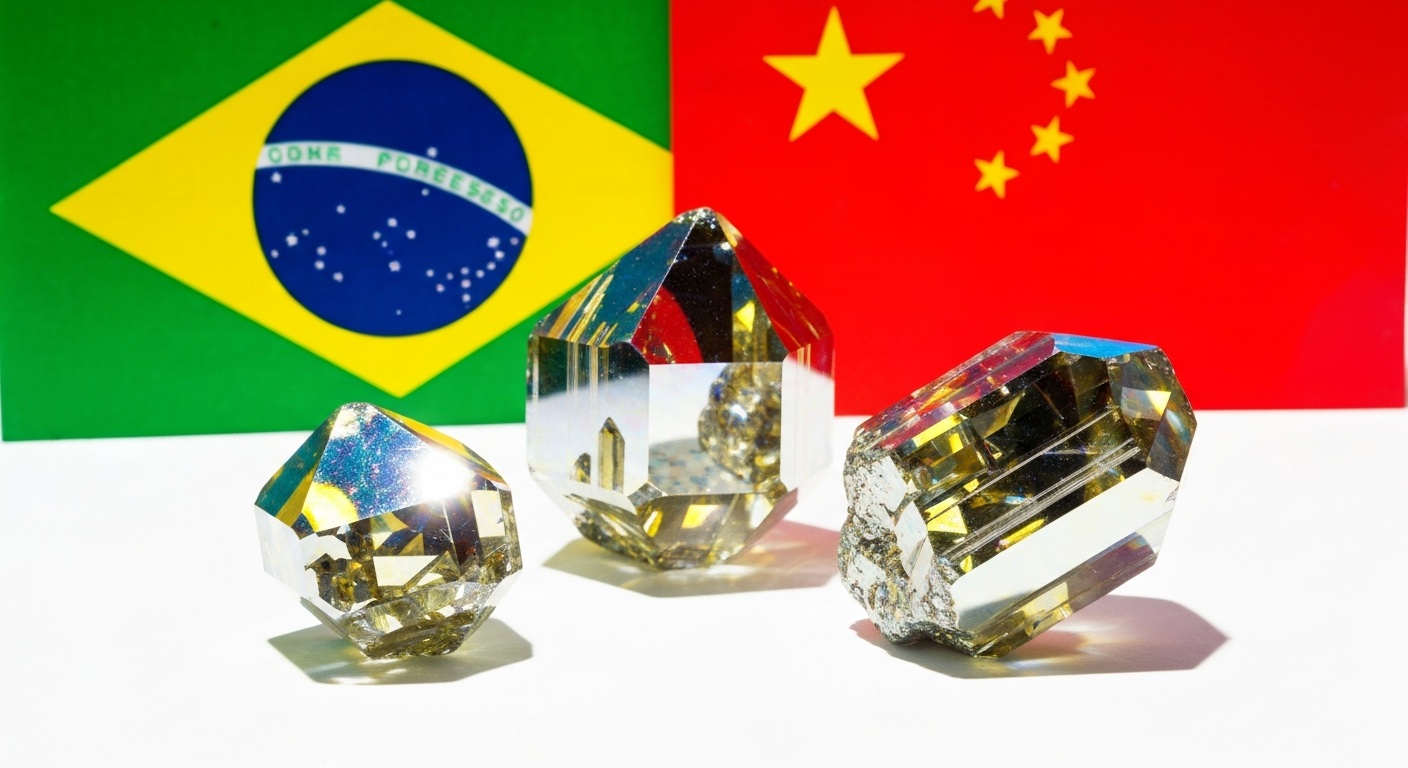
In April 2025, China restricted the export of seven heavy rare earth minerals to the United States. In response, Trump signed an executive order giving the U.S. 180 days — a deadline falling in August 2026 — to reduce its dependence on Chinese critical minerals. Amidst this tug-of-war, there is a country with the planet's second-largest reserve that almost no one mentions: Brazil.
This article explains what rare earths are, why China controls the market, what Trump intends to do about it, and how Brazil can benefit — or fall into a trap — in this billion-dollar geopolitical game.
What are rare earths and why they move the modern world
Rare earths are a group of 17 chemical elements — the 15 lanthanides plus scandium and yttrium. Despite the name, they are not exactly rare in the Earth's crust. Cerium, for example, is more abundant than copper. The problem is that they appear scattered in low concentrations, which makes extraction expensive and polluting.
These elements are indispensable for contemporary technology. Neodymium and praseodymium go into the permanent magnets of electric motors and wind turbines. Dysprosium allows these magnets to function at high temperatures. Europium and terbium are essential for smartphone screens. Gadolinium is used in magnetic resonance imaging. Without rare earths, there are no electric cars, no F-35 fighters, no iPhones.
Global demand has exploded in recent years. The rare earths market moved about US$ 5.5 billion in 2024 and is projected to reach US$ 9 billion by 2030, driven by the energy transition and the arms race. And one single country controls the largest share of this market.
China controls about 34% of the reserves and 70% of global production — and uses it as a weapon
According to the USGS (United States Geological Survey), China holds about 44 million tons in rare earth reserves and accounted for approximately 70% of world production in 2024, with around 240,000 tons of rare earth oxides (REO). But the dominance goes beyond mining: China controls more than 85% of the global processing and refining of these minerals.
Deng Xiaoping said in 1992 that "the Middle East has oil, and China has rare earths." Three decades later, that phrase became doctrine. Beijing invested decades in refining capacity while the rest of the world outsourced. The result is an almost monopolistic supply chain.
China has already used this advantage as a tool of pressure. In 2010, it cut exports to Japan during a territorial dispute. In 2025, after Trump's tariff escalation, Beijing restricted the export of dysprosium, terbium, lutetium, and other heavy elements — precisely those most critical to the American military industry. The message is clear: those who depend on China for rare earths are vulnerable.
Trump's executive order: 180 days to build a supply chain outside of China
In March 2025, President Donald Trump signed an executive order invoking the Defense Production Act to accelerate the exploration of critical minerals on American territory. The decree established a 180-day deadline for federal agencies to present concrete plans to reduce dependence on China — which puts the deadline around August-September 2025, with projected developments for 2026.
The plan includes accelerating mining permits, creating strategic stockpiles, and funding partnerships with allied countries. The U.S. Department of Defense has already invested US$ 439 million in rare earth projects since 2020, including the Mountain Pass mine in California — the only rare earth mine in operation in the U.S., which produced about 43,000 tons of REO in 2024.
But mining is just the beginning. The real bottleneck is processing. Even the ore extracted at Mountain Pass needs to be sent to China for refining. Building processing capacity takes years, not months. And this is where international partners come into the equation — with Brazil at the top of the list.
Brazil: 21 million tons and an opportunity that may not repeat itself
The USGS estimates that Brazil has 21 million tons in rare earth reserves, the second largest in the world, behind only China and ahead of Vietnam (22 million, according to some estimates) and Russia (21 million). Brazilian deposits are concentrated mainly in Goiás, Minas Gerais, and Bahia.
The problem is that reserve is not production. Brazil produced only about 100 tons of REO in 2024 — a fraction of the global market. There is no significant domestic processing capacity. Existing projects are in the initial stage or face years of environmental licensing.
Compare this to the trajectory of niobium. Brazil controls over 85% of the world's niobium production, mainly thanks to CBMM (Companhia Brasileira de Metalurgia e Mineração), a Brazilian company based in Araxá, Minas Gerais, which completed 70 years in 2025. CBMM transformed niobium from a geological curiosity into a high-tech product, with applications in special steels, aerospace alloys, and even lithium batteries. This is the model to follow.
CBMM and Vale: the companies that can lead the Brazilian race
CBMM has already demonstrated that it is possible to build a vertically integrated chain of strategic minerals in Brazil. The company not only extracts niobium — it develops application technology, has R&D laboratories, and exports high-value-added products to more than 40 countries. CBMM's 2024 sustainability report reinforces its focus on innovation and minerals for the energy transition.
Vale, the world's largest iron ore producer, has rare earth projects as a byproduct of its operations. Serra dos Carajás, in Pará, contains significant deposits. But Vale has historically prioritized bulk commodities (iron, nickel) over niche minerals.
Smaller companies are also in the race. Serra Verde, in Goiás, began producing rare earth concentrate in 2024, potentially becoming Brazil's first dedicated rare earth mine on a commercial scale. The company has partnerships with international investors and targets exports to the U.S. and Europe.
The challenge is scaling up. Building a rare earth mine takes 7 to 15 years from feasibility study to full production. Processing requires chemical reagents, management of radioactive waste (many deposits contain thorium and uranium), and expertise that Brazil has not yet mastered on an industrial scale.
Opportunity or trap: the risks no one wants to discuss
The optimistic narrative is seductive: Brazil has the reserves, the U.S. has the demand, all that's needed is to connect the two. But Brazilian economic history teaches caution. The country has already lived through cycles of exporting raw materials — sugar, rubber, coffee, iron ore — that generated temporary wealth without creating a permanent processing industry.
The main risk is becoming a supplier of raw ore. If Brazil exports rare earth concentrate to be processed in the U.S. or China, it captures a minimal fraction of the value. A kilogram of raw ore is worth cents. A kilogram of separated neodymium oxide is worth US$ 60-80. A finished neodymium magnet is worth hundreds of dollars per kilogram. The value multiplies at each processing stage.
Another risk is environmental. Rare earth mining generates toxic waste, and in many deposits, radioactive material. China accepted this environmental cost for decades — Baotou, in Inner Mongolia, has a man-made lake of toxic waste visible from space. Brazil, with the Amazon and Cerrado as sensitive biomes, needs strict standards. But strict environmental standards cost money and time, which reduces price competitiveness.
There is also the geopolitical risk. Aligning exclusively with the U.S. in the rare earth supply chain could irritate China, which has been Brazil's largest trading partner since 2009, buying soybeans, iron ore, and oil. The diplomatic balance is delicate. Brasília needs to avoid being forced to choose sides.
What this means for the Brazilian economy: jobs, investment, and sovereignty
If done correctly, the development of the rare earth supply chain could generate between 15,000 and 50,000 direct and indirect jobs in Brazil over the next decade, according to estimates from mineral sector consultancies. Mining engineers, processing chemists, environmental technicians, logistics operators — the demand for skilled labor would be significant.
The required investment is large. Building mining and processing capacity to produce, say, 20,000 tons of REO per year (about 5-6% of the global market) would require something between US$ 3 and 5 billion in investments over a decade. This money could come from public-private partnerships, American, European, or Japanese funds — all desperate for alternatives to China.
Japan, by the way, is a natural partner. After the scare in 2010, when China cut exports, Japan invested heavily in rare earth recycling and supplier diversification. JOGMEC (Japan's Metals and Energy Agency) already has cooperation projects with countries in South America and Africa.
The fundamental issue is technological sovereignty. Brazil can continue to be an exporter of raw materials, as it does with soy and iron ore, or it can use rare earths as a lever to move up the value chain. Separating oxides, producing alloys, manufacturing permanent magnets — each step adds value and creates higher-skilled jobs.
The deadline is now: why the next 3-5 years are decisive
The window of opportunity is not eternal. Other countries are moving. Australia has Lynas Rare Earths, which already operates the largest refinery outside of China in Malaysia and is building capacity in the U.S. Canada has advanced projects in Quebec and the Northwest Territories. India is reactivating dormant projects.
If Brazil takes another decade to get projects off the ground, by the time production begins, the market will have already reorganized without it. The competitive advantage of having large reserves dilutes when other countries build a processing chain first.
Trump's deadline — August 2026 — is symbolic, but it signals real urgency. The U.S. is actively seeking alternative suppliers and is willing to put money on the table. The U.S. Department of State has already signaled interest in bilateral critical minerals agreements with Latin American countries. Brazil needs to be prepared for these conversations with concrete projects, not just reserves underground.
The rare earth race is not about geology. It's about industrial capacity, political will, and strategic vision. Brazil has the first. It needs to demonstrate the other two.
It's worth remembering that China did not build its dominance by accident. It was four decades of coordinated industrial policy: subsidies, training of specialized engineers, calculated environmental tolerance, and state control of the supply chain. Replicating this in a democratic regime with modern environmental standards is more difficult, but not impossible. Australia is proving it's possible to compete with clear rules. Brazil can do the same — if it treats rare earths as a state project, not just another commodity to export in its raw form.
The moment is rare. The combination of geopolitical tension, growing demand, and available capital creates a window that Brazil hasn't seen since the pre-salt boom. The difference is that this time, the resource underground is not enough. What will determine whether Brazil captures value or repeats the colonial pattern of raw export is the political decision to invest in processing, in skilled people, and in smart diplomacy that keeps doors open with both Washington and Beijing at the same time.
This topic was featured on China to Watch — where we closely follow the geopolitical movements between China, the U.S., and the countries caught in the crossfire. Subscribe to the newsletter to not miss the next analyses.