A Port that Works Alone — Literally
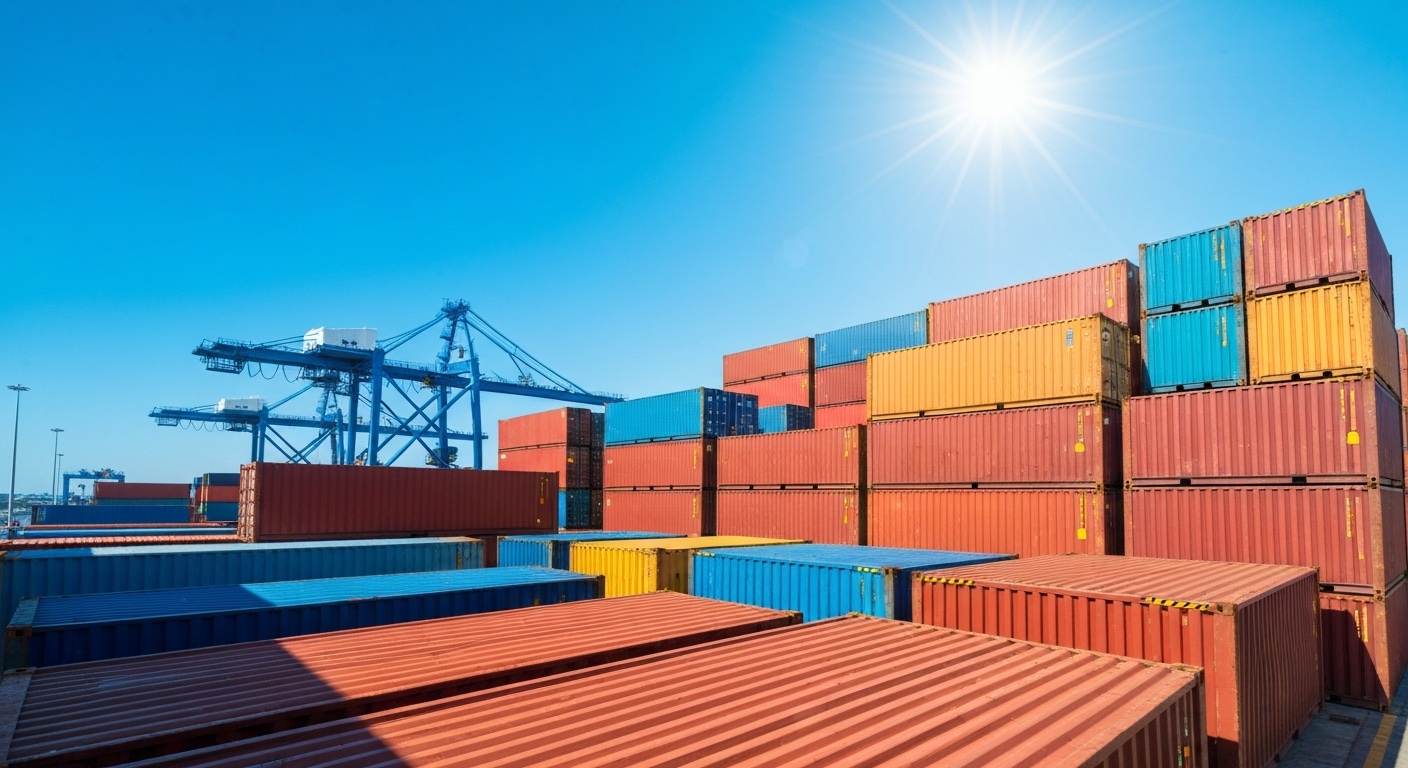
Imagine a port terminal where cranes move 40-ton containers, vehicles carry goods between yards and ships are moored and unloaded — all this without a single person on site. It seems like science fiction, but it is the daily reality of the Port of Qingdao, in Shandong province, on the eastern coast of China.
The Port of Qingdao is one of the top ten largest in the world in terms of cargo volume, holding the seventh global position. But what stands out is not just the size: it is the level of automation that has transformed the Qianwan container terminal into a living laboratory of what port logistics can be when cutting-edge technology takes center stage.
In this article, we will examine how this fully automated operation works, what technologies are behind it, and what it means when we look at Brazilian ports like Santos and Paranaguá.
The Structure of the Port of Qingdao
The port is divided into four major operational areas, each so large that they are often treated as independent ports: Dagang, Qianwan, Huangdong (specialized in oil tankers), and Dongjiakou, located 40 km south of Qingdao city.
Together, these areas handle iron ore, petroleum, containers, and general cargo. The Qianwan container terminal, where total automation has been implemented, is the crown jewel. There, the operation runs 24 hours a day, seven days a week, with millimeter precision and without breaks for rest, shift changes, or human error.
The port complex is also part of the 21st Century Maritime Silk Road, connecting the Chinese coast to Singapore, India, Mombasa in Kenya, passing through the Suez Canal to the Mediterranean and reaching the port of Trieste, Italy, with connections to Central Europe and the North Sea. In other words, what leaves Qingdao reaches the entire world.
For perspective: the Dongjiakou port alone is 40 kilometers from the center of Qingdao and was built from scratch to serve as a heavy cargo hub, especially for iron ore. The scale of planning involved in building these four port areas is hard to compare with any port infrastructure project in the Southern Hemisphere.
5G, Artificial Intelligence, and Autonomous Vehicles: The Three Pillars of Automation
The automation of the Port of Qingdao rests on three technological pillars that work in an integrated manner.
Dedicated 5G Network: The terminal operates with a private 5G network that guarantees ultra-low latency — we are talking about milliseconds. This speed is essential for commands sent to cranes and vehicles to be executed in real time, without delays that could cause accidents or operational bottlenecks. Each crane, each AGV, and each sensor in the yard is connected to this network, continuously transmitting data to the central system.
Artificial Intelligence for Decision and Coordination: A central AI system coordinates all the logistics of the terminal. It decides which crane operates which ship, plots routes for autonomous vehicles, optimizes container stacking in the yards, and makes real-time adjustments as conditions change — early arrival of a ship, weather changes, cargo priority. The system also learns from historical data: the more it operates, the more efficient it becomes. It is the opposite of a human operator who has good days and bad days.
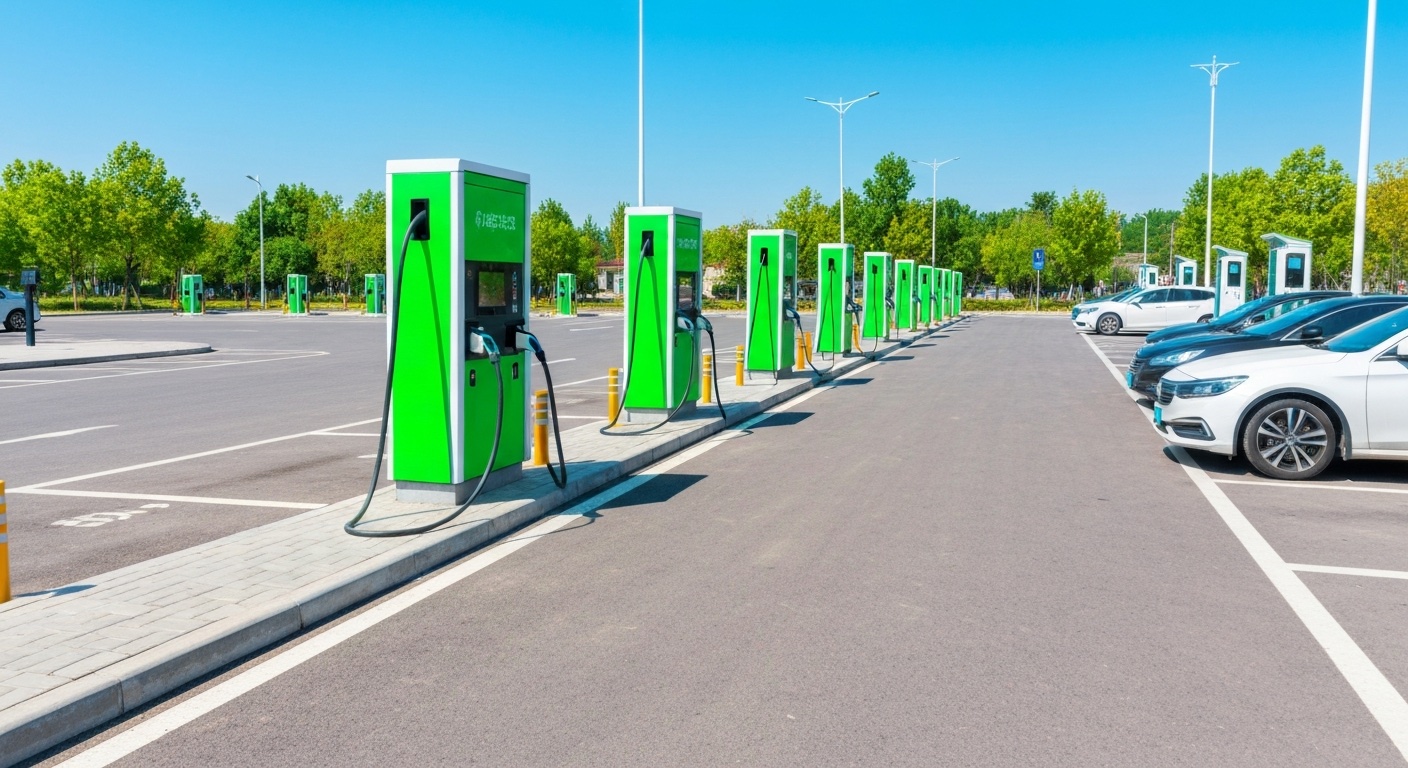
AGVs (Automated Guided Vehicles): Automated guided vehicles are the muscle of the operation. They transport containers between the quay and storage yards, following routes optimized by AI. They have no driver, no need for breaks, and operate on electric power, reducing the port's carbon footprint. When the battery is low, the vehicle itself goes to a charging station and another takes over its route — without interrupting the operation.
In 2021, Qingdao went even further: it inaugurated the world's first suspended monorail system capable of transporting loaded 20 and 40-foot containers. The system began construction in 2020 and went into operation the following year, adding another layer of logistics innovation that no other port on the planet had attempted. This monorail is not an adapted passenger train — it was specifically designed to move fully loaded containers above the ground, freeing up yard space and reducing traffic conflicts between AGVs.
Zero Humans on the Quay: How it Works in Practice
When we say "zero humans," it is not a figure of speech. In the automated Qianwan terminal, the operational area — quay, container yards, transport lanes — has no operators, drivers, or stevedores physically present.
The ship-to-shore cranes are remotely operated from a control room. An operator, comfortably seated in front of multiple screens, supervises several cranes simultaneously. High-definition cameras, LiDAR sensors, and positioning systems ensure a complete view of the operation — often better than if the operator were in a crane cabin at 50 meters height.
The AGVs move through the terminal following routes defined by AI. If an obstacle appears, the vehicle stops, recalculates, and proceeds. If a container needs to be repositioned, the central system automatically reorganizes the queue. There is no radio chatter, no shouting on the quay, no signaling gestures. All communication is digital, between machines.
The practical result: the productivity of the automated terminal has surpassed that of manually operated terminals. The error rate has dropped dramatically. And operating costs — mainly labor and energy — have decreased significantly. In addition, safety has greatly improved: with no people in the cargo movement areas, workplace accidents in these zones have dropped to zero.
Strategic Alliances and Qingdao's Global Position
The Port of Qingdao does not operate in isolation. In 2011, it formed a strategic alliance with three other ports in Shandong province — Yantai, Rizhao, and Weihai — and with the Port of Busan, the largest in South Korea. The goal: to build a logistics and shipping center in Northeast Asia.
This alliance is not just a paper agreement. It allows for coordination of routes, sharing of infrastructure, and joint capacity planning. When one port is congested, traffic can be redirected to another in the alliance with available capacity. It is logistics conceived as a network, not as isolated points.
In 2014, Qingdao Port International Co. Ltd. sought to raise up to US$377 million in an initial public offering (IPO) in Hong Kong, signaling international expansion ambitions. The port also consolidated as the first in China to exceed 1 million TEUs (unit equivalent to a 20-foot container) in combined sea-rail transport, integrating logistics chains that go far beyond the quay.
This long-term vision — heavy investment in technology, regional alliances, and multimodal logistics integration — is what places Qingdao in a position that few ports in the world can achieve.
And the Brazilian Ports? Where do Santos and Paranaguá fit in
Now comes the painful part. The Port of Santos, the largest in Latin America, moved about 170 million tons in 2023. It is a respectable number, but the operation still heavily depends on manual labor, equipment that in many cases has been in use for decades, and road access infrastructure synonymous with congestion.
The Port of Paranaguá, the second largest in Brazil for grain exports, faces similar challenges: lines of trucks stretching for kilometers, bureaucratic processes that delay clearances, and technology investments that, when they happen, arrive years behind what is already standard in Asia.
For perspective: while Qingdao operates a suspended monorail transporting containers and driverless electric AGVs, many Brazilian terminals still debate the viability of implementing automatic container scanners. While China operates dedicated 5G networks in its terminals, Brazilian ports still deal with radio communication failures.
This is not to belittle what Brazilian ports do — they are vital to the country's economy and move impressive volumes of soybeans, ore, sugar, and meat that feed the world. But the technological gap is real and widening. And this gap has a cost: every extra hour a ship waits to dock, every container that takes longer to locate in the yard, every truck idling in line — all of this translates into lost money and eroded competitiveness.
Brazilian agribusiness, which depends on these ports to export its production, feels this cost directly. A soybean exporter who misses a shipping window due to operational delays loses real money. And the Chinese buyer on the other end — often receiving that soybean precisely through the Port of Qingdao — operates with an efficiency that makes this contrast even more stark.
What Brazil can learn from Qingdao
The lesson from Qingdao is not "copy everything." China has invested billions and has specific economic and political conditions that enabled this transformation. But there are principles that can — and should — be adapted:
Investment in Digital Infrastructure: Before automating cranes, connectivity is needed. A dedicated 5G network in a port terminal is not a luxury — it is a prerequisite for any serious level of automation. Brazil is deploying 5G in cities, but the conversation about industrial 5G in ports has barely begun.
Multimodal Integration: Qingdao is not just a port. It is port + railway + monorail + international maritime route. In Brazil, the disconnection between port, railway, and road is one of the biggest logistical bottlenecks. Most cargo arrives at ports by truck, the most expensive and least efficient mode for large volumes.
Long-term Planning: Qingdao's suspended monorail was planned years before construction began. In Brazil, many port projects live within four-year political cycles, without continuity. The government changes, the plan changes. And the port stays the same.
Reducing dependence on manual labor in repetitive operations: This does not mean eliminating jobs — it means reallocating people to supervisory, maintenance, and data analysis functions, where added value is greater and working conditions are better. A remote crane operator in an air-conditioned room enjoys incomparable quality of life compared to someone working under sun and rain at 50 meters height.
The Future of Port Logistics has Arrived — It's Just Not Evenly Distributed
The Port of Qingdao is a clear picture of where global logistics is heading. Automated terminals, operated by AI, connected by 5G, without human presence in operational areas — this is no longer a pilot project. It is a commercial reality, moving millions of containers per year.
For Brazil, the question is not whether this transformation will come, but when — and whether the country will be ready. Each year of delay in modernizing Brazilian ports is another year of lost competitiveness against economies that already operate at the next level.
Qingdao shows it is possible. The technology exists. The model is validated. What is often missing is political will, strategic vision, and patient capital willing to invest in infrastructure that delivers returns over decades, not quarters.
China is not waiting for the future to arrive. It is building it. And ports like Qingdao prove that when you decide to invest seriously, the results are transformative.
To follow how China is shaping the future of technology, logistics, and infrastructure — and what this means for the world — follow chinato.watch. We publish in-depth, unfiltered analyses of what is really happening on the other side of the world.