
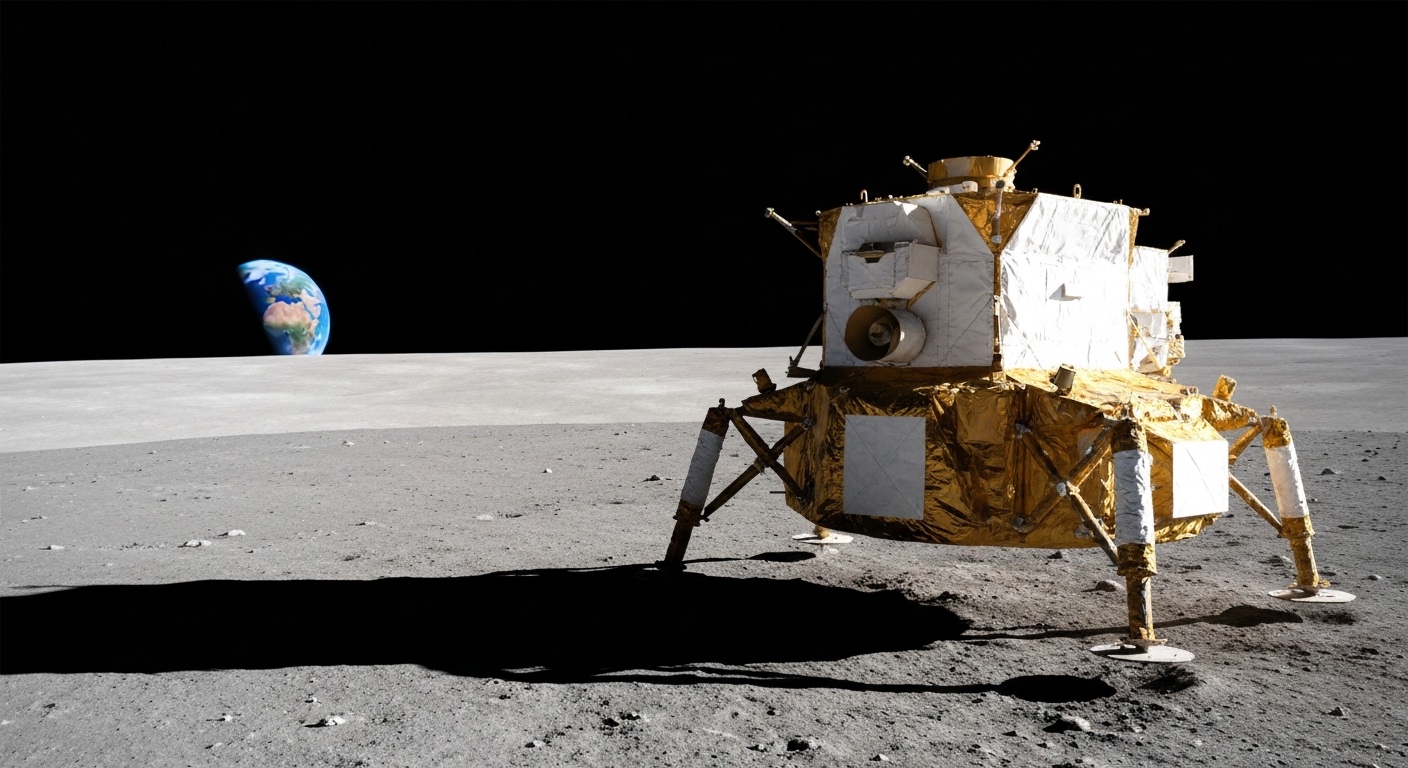
The new space race is not science fiction — it has already begun
In December 1972, Eugene Cernan left the last human footprints on the lunar surface during the Apollo 17 mission. More than five decades later, the Moon has returned to the center of global geopolitical contention. This time, there are two protagonists: the United States, with NASA's Artemis program, and China, with the China Lunar Exploration Program (CLEP) of CNSA.
The question that dominates space conferences, intelligence reports, and diplomatic negotiation tables is straightforward: who will step on the Moon first this decade?
The answer depends on rockets, budgets, domestic politics, and a considerable dose of engineering that does not yet exist. Let's go to the facts.
The Chinese lunar program: from Chang'e 1 to manned landing
China began its lunar program in January 2004, named Project Chang'e in honor of the Moon goddess in Chinese mythology. Since then, the country has accumulated nine consecutive successful missions — a record that no other space agency can match in the same period.
The program was divided into four phases, each more ambitious than the previous one:
- Phase I — Orbiters: Chang'e 1 (2007) and Chang'e 2 (2010) mapped the lunar surface in high definition and tested the telemetry network with 50-meter antennas in Beijing and 40-meter antennas in Kunming, Shanghai, and Ürümqi, forming a VLBI network of 3,000 km.
- Phase II — Landings and rovers: Chang'e 3 (2013) made the first Chinese lunar landing, carrying the Yutu rover to the Mare Imbrium. Chang'e 4 (2019) made history by landing for the first time on the far side of the Moon, in the South Pole-Aitken, with the Yutu-2 rover.
- Phase III — Sample return: Chang'e 5 (2020) landed near Mons Rümker and brought back 1,731 grams of lunar soil — the first lunar sample collection in more than four decades, since the Soviet mission Luna 24 in 1976.
- Phase IV — Robotic research station: Chang'e 6 (May 2024) collected and returned samples from the far side of the Moon, in the Apollo Basin. Chang'e 7, scheduled for 2026, will explore the lunar south pole with an orbiter, a landing module, and an airship. Chang'e 8, scheduled for 2028, will test in-situ resource utilization (ISRU) technologies, including 3D printing with lunar material.
Each mission served as a technological demonstration for the next. The result is an increasing complexity ladder that culminates in the declared objective in July 2023: to land two astronauts on the Moon by 2030.
Long March 10 and Mengzhou: the hardware for manned landing
To take astronauts to the Moon, China is developing the Long March 10 (长征十号), a super-heavy rocket 92.5 meters tall and 2,189 tons at liftoff. The vehicle can place 70 tons in low Earth orbit (LEO) and 27 tons in translunar injection trajectory (TLI).
The standard configuration uses three stages plus two lateral boosters, all with a 5-meter diameter. The boosters and the first stage are equipped with 7 YF-100K engines each, totaling 21 engines burning at liftoff — a combined thrust of 17,500 kN at sea level. The second stage uses 2 YF-100M engines, and the third stage, 3 YF-75E engines powered by liquid hydrogen.
In April 2024, CNSA announced that the program development was complete. The first flight of the rocket is scheduled for 2027.
The manned lunar mission requires two launches of the Long March 10: one carrying the Mengzhou (梦舟, "Boat of Dreams") capsule with the astronauts, and another carrying the Lanyue (揽月, "Embrace the Moon") landing module. The two vehicles would meet in lunar orbit before landing.
Zhang Hailian, deputy chief designer of China Manned Space Agency (CMSA), publicly presented this plan at the 9th China Commercial Aerospace Forum in Wuhan in July 2023. In September 2024, CMSA unveiled the extravehicular lunar spacesuit in Chongqing.
Artemis program: American ambition with chronic delays
On the American side, the Artemis program was formally established in 2017 by Space Policy Directive 1. The objective: to re-establish human presence on the Moon and create the basis for future missions to Mars.
The program relies on three pillars: the Space Launch System (SLS) rocket, the Orion capsule, and the Starship HLS from SpaceX as the human landing system. As of November 2025, the official schedule was:
- Artemis I (November 2022): uncrewed flight of SLS and Orion. Successfully completed.
- Artemis II (April 2026): first crewed flight, with 4 astronauts on a free return trajectory around the Moon.
- Artemis III (mid-2027): first crewed lunar landing since Apollo 17. Depends on Starship HLS being operational in near-rectilinear halo orbit (NRHO).
- Artemis IV (end of 2028): second landing, with docking to the Lunar Gateway.
- Artemis V (beginning of 2030): third landing, with delivery of the ESPRIT module from ESA and Canadarm3.
These deadlines should be read with skepticism. The first Orion flight on SLS was originally scheduled for 2016 — it happened six years later, in 2022. Mission Artemis III has already been delayed multiple times. The dependence on Starship HLS, which needs to demonstrate orbital refueling before any lunar landing, adds another layer of technical uncertainty.
The cumulative cost of the program between 2012 and 2025 reached USD 93 billion, according to the NASA Inspector General's Office. Just in the period 2021–2025, it was USD 53 billion. The program faced existential threats in the US Congress, ultimately being sustained by the approval of the One Big Beautiful Bill Act of 2025.
Lunar south pole: why everyone wants the same piece of Moon
The convergence of both programs to the lunar south pole is not a coincidence. This region concentrates the most valuable resources for sustainable exploration:
- Water ice: craters permanently shaded at the south pole contain confirmed deposits of water ice by multiple missions, including the Indian Chandrayaan-1 probe and NASA's LCROSS instrument. This water can be converted into breathable oxygen and liquid hydrogen and oxygen — rocket fuel. A lunar base with access to local water does not need to transport every liter from Earth, dramatically reducing the cost of sustained operations.
- Helium-3: the lunar regolith contains helium-3, a rare isotope on Earth but relatively abundant on the Moon due to direct exposure to the solar wind. Helium-3 is considered an ideal fuel for future aneutronic nuclear fusion — a reaction that would produce energy with minimal residual radiation. Although helium-3 fusion technology does not exist commercially yet, the potential energy is immense: it is estimated that 100 tons of helium-3 could meet the global energy demand for a year.
- Eternal light peaks: some elevations near the south pole receive almost continuous sunlight, allowing stable solar energy generation — a critical resource for any permanent base.
Whoever controls the infrastructure to access these resources will have a strategic advantage not only in lunar exploration but in the entire cis-lunar economy of the coming decades.
ILRS vs Lunar Gateway: two visions of lunar base
The dispute is not just about who lands first. It is about who builds the permanent infrastructure — and with which allies.
China leads the International Lunar Research Station (ILRS), a joint project with Russia announced in March 2021. The station will be built on the lunar surface or in lunar orbit, with capacity for multidisciplinary research, long-term autonomous operation, and in-situ resource use.
The ILRS schedule is divided into three phases: reconnaissance (2021–2025), construction (2026–2035), and utilization (from 2036). Missions Chang'e 7 and 8 are the direct precursors to the construction phase.
The project has attracted a coalition of 13 countries: China, Russia, Venezuela, South Africa, Azerbaijan, Pakistan, Belarus, Egypt, Thailand, Nicaragua, Serbia, Kazakhstan, and Senegal. It is not exactly the G7 — but it is a global network with access to ground stations (Venezuela), technical capacity in radio astronomy (South Africa via SARAO), and diplomatic weight in the Global South.
On the American side, the Lunar Gateway is a lunar orbit space station that will serve as a support point for Artemis missions. The first module is to be delivered by the Artemis IV mission, scheduled for the end of 2028. The Gateway is a multinational project involving NASA, ESA, JAXA, CSA, and other agencies signing the Artemis Accords.
The differences in approach are telling. The ILRS prioritizes presence on the surface, use of local resources, and operational autonomy. The Gateway prioritizes orbital flexibility, cooperation with traditional allies, and integration with the American commercial ecosystem (SpaceX, Blue Origin).
In geopolitical terms, we are seeing the formation of two lunar blocs — mirroring terrestrial dynamics, but projected 384,400 km above.
Direct comparison: schedules and risks
Putting the programs side by side:
- China: first flight of the Long March 10 scheduled for 2027. Manned landing by 2030. Record of 9/9 successful lunar missions. Main risk: integration of two launches and rendezvous in lunar orbit, never done before by China. No dependence on external private suppliers.
- USA: Artemis III (first landing) planned for mid-2027, but depends on Starship HLS being ready — including orbital refueling. Recent history of significant delays (SLS delayed 6 years). Budget under constant political pressure. Advantage: historical experience with Apollo and robust private ecosystem.
If both fulfill their official schedules, the USA would land first, in 2027. But the history of Artemis delays suggests that 2028 or 2029 is more realistic for Artemis III. China, on the other hand, has shown the ability to meet deadlines — Chang'e 5 and Chang'e 6 were carried out within the planned schedule.
The most honest assessment: it is a genuinely open race. Either of the two can arrive first, and the margin depends on technical variables that no analyst can predict with certainty.
What is really at stake
Reducing this contest to "who plants the flag first" is to miss the point. What is at stake is:
- Legal precedent: whoever establishes presence first defines de facto standards for access and use of lunar resources — regardless of what existing space treaties say.
- Cis-lunar supply chain: the infrastructure for extracting water and producing fuel on the Moon will be the basis of the space economy in the coming decades.
- Technological alliances: participating in the ILRS or the Artemis Accords defines with whom a country shares technology, data, and access. It is a long-term geopolitical choice.
- Prestige and narrative: for China, landing astronauts on the Moon is the ultimate validation of its technological development model. For the USA, not being able to repeat the 1969 feat in a timely manner would be a strategic humiliation.
The factor no one controls
There is one element that both programs underestimate: the Moon does not cooperate. The lunar environment is brutal — temperatures ranging from +127°C to -173°C, abrasive regolith that destroys equipment, cosmic radiation without atmospheric protection, and 14 consecutive days of total darkness away from the poles.
Neither of the two powers has landed humans on another celestial body in this century. The last time that happened, computers had less processing power than a modern calculator. Engineering has advanced immensely, but the fundamental challenge remains: keeping humans alive in an environment that wants to kill them.
Where this is going
The next concrete milestones to watch are:
- 2026: launch of Chang'e 7 to the lunar south pole and first flight of Long March 10A (variant for LEO). Artemis II takes astronauts around the Moon.
- 2027: first full flight of Long March 10. Window for Artemis III, if the Starship HLS is ready.
- 2028: Chang'e 8 tests ISRU on the Moon. Artemis IV and first modules of the Gateway.
- 2029–2030: window for the Chinese manned landing. Artemis V with expanded Gateway.
What is certain: by 2030, at least one — and possibly both — of these programs will have put humans on the lunar surface. The 21st century's lunar race is not a repeat of the Cold War. It is more complex, involves more actors, and has more tangible economic consequences.
And this time, whoever arrives first will not just plant a flag. They will start building.
Follow the space race with China to Watch
The dispute between China and the USA for the Moon is just one front of the technological and geopolitical competition that is redefining the 21st century. At China to Watch, we translate primary Chinese sources, analyze data, and explain what is really happening — without ideological filters, without hype.
If you want to understand the real China, subscribe to our newsletter and receive analyses like this straight to your email. The next decade will be decisive — and you don't have to wait for the news to translate.
Publication sources
- Chinese Lunar Exploration Program — Wikipedia ↗
- Artemis program — Wikipedia ↗
- Long March 10 — Wikipedia ↗
- International Lunar Research Station — Wikipedia ↗
- NASA OIG — Artemis Program Costs (2021) ↗
- CMSA — Zhang Hailian apresentação, 9º Fórum Comercial Aeroespacial da China, Wuhan, julho 2023 ↗
- CNSA — Revelação do traje lunar extravehicular, Chongqing, setembro 2024 ↗