What is Chunyun?
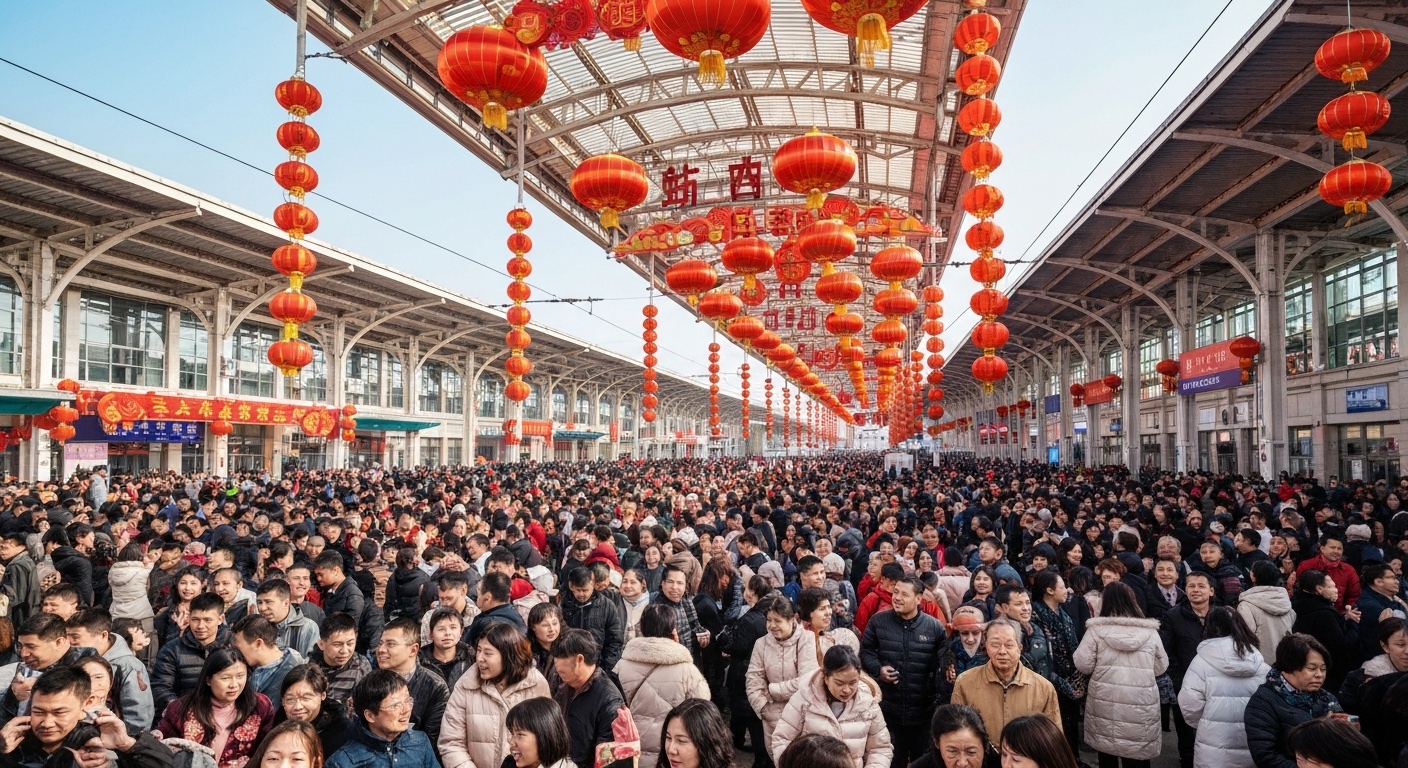
Chunyun (春运, chūnyùn) literally means "spring transport". The term refers to the approximately 40-day period of massive movement in China around the Lunar New Year — the most important holiday in the Chinese calendar. The window begins about 15 days before the eve of the New Year and extends for 25 days afterward, covering both the departure and return of travelers.
To give an idea of the scale: in 2016, the Chinese government projected 2.9 billion passenger trips during that year's chunyun, according to official data cited by state media. In the following years, the number fluctuated between 2.8 and 3 billion — depending on variables such as weather, economic growth, and, more recently, the prolonged effects of the Covid-19 pandemic.
Chunyun is often called the largest annual human migration on the planet. No other event in the world concentrates so many trips in such a short time.
Why do so many people travel at the same time?
Three factors explain the phenomenon:
1. The tradition of the family reunion dinner. Chinese New Year revolves around family. On the eve, it is customary for all members to gather for the niányèfàn (年夜饭), the reunion dinner. For hundreds of millions of migrant workers who left their hometowns for industrial and commercial hubs like Shenzhen, Guangzhou, Shanghai, and Beijing, this is the only time of the year when they return home.
2. The mass of migrant workers. Since the economic reforms that began in the late 1970s, China has experienced an unprecedented rural exodus. In the early 2000s, it was estimated that between 150 million and 200 million people lived away from their registered cities (hukou). By 2024, the number of rural migrant workers exceeded 290 million, according to China's National Bureau of Statistics. A large part of them travels during the chunyun.
3. University students. Chinese universities' winter break coincides with the Spring Festival period. Among the 194 million railway passengers of the 2006 chunyun, for example, 6.95 million were students — and the university contingent has grown significantly since then.
Added to all this is the fact that Chinese New Year is one of the country's only two extended holidays (the other is National Day, on October 1st). Many people take advantage of the week off to travel for leisure, further overwhelming the system.
The numbers that defy imagination
Some data helps to size up the chunyun:
- 2.9 billion trips projected in 2016, according to China's Ministry of Transportation — almost double the country's population in accumulated movements over the 40 days.
- 9 billion trips projected for the 2025 chunyun (January-February), including all modes, according to official projections released by the Chinese government — an absolute record driven by post-pandemic recovery and the extended 8-day holiday.
- 340 million railway passengers estimated during the 2009 chunyun, when the average daily train capacity was only 3.4 million people per day — leading to queues of over 24 hours at stations.
- 86 million road trips during the 2012 Golden Week, when the government waived tolls on national highways — a 13% increase compared to the previous year.
- Over 100,000 people were stranded at the same time at Guangzhou railway station during snowstorms in January 2008. The government mobilized 1.3 million soldiers and reservists to clear roads and railway lines.
To contextualize: if we divide 2.9 billion trips by 40 days, we get an average of 72.5 million movements per day. At peak times, this number is even higher — especially on the days immediately before the eve and immediately after the holiday ends.
Railways: the beating heart of the chunyun
Rail transport is the most in-demand — and most pressured — mode during the period. China has the world's largest high-speed network, with over 45,000 kilometers of tracks dedicated to bullet trains (as of 2024), but even this colossal infrastructure is not enough to absorb the demand of the chunyun.
Each year, hundreds of temporary trains (línkè, 临客) are added to the regular schedule. Temporary ticket sales offices are set up in station squares. Factories and universities organize collective ticket purchases to distribute in advance to employees and students.
Even with these measures, problems persist. Before the digitalization of tickets, the ticket scalping market (huángniú, 黄牛 — literally "yellow cow") was endemic. Scalpers would buy batches of tickets minutes after sales opened and resell them at inflated prices near stations. In Shenzhen, it was estimated that 23 days of tickets could run out in 14 minutes if sold only by phone.
From 2010, the government introduced the requirement of real-name and identity document tied to the railway ticket, a measure that reduced (but did not eliminate) the action of scalpers. Since 2012, all train tickets in China require identification.
Roads: the other giant
If railways carry hundreds of millions, roads move billions. Most of the chunyun's movements happen by road — on intercity buses, vans, and, increasingly, in private cars.
The expansion of the middle class and car access has turned Chinese roads into scenes of epic congestion during the period. Dozens of kilometers of gridlock are routine on the main highways leaving Beijing, Shanghai, and the Pearl River Delta metropolises.
In 2012, the government's decision to waive tolls on national highways during the Golden Week caused a 13% jump in road traffic. Since then, the policy of toll exemption on national holidays has become standard, encouraging even more car travel.
Bus companies, in turn, face recurrent accusations of overloading vehicles and forcing drivers to make irregular journeys to maximize profits, which raises the accident rate. The government has stepped up enforcement, but the problem persists in less developed areas.
Aviation and water transport
Air transport has historically been less affected by the chunyun, as most migrant workers cannot afford plane tickets. Nevertheless, the impact is growing. In 2008, about 28 million passengers flew during the period. In 2009, the Civil Aviation Administration of China's (CAAC) projection was already 36 million.
With the expansion of low-cost airlines in the last decade, air travel has been gaining market share. Companies like Xiamen Airlines have added over 200 extra flights to their network during the chunyun. In recent years, projections point to more than 90 million passengers flying during the 40-day period.
River and sea transport also face additional pressure, especially on routes to islands and coastal areas, but on a much smaller scale than other modes.
The Spring Festival: what's behind the journey
To understand the chunyun, it is necessary to understand the cultural weight of Chinese New Year — or the Spring Festival (Chūnjié, 春节). It is the most important celebration in Chinese culture, with roots dating back thousands of years.
The festival follows the Chinese lunisolar calendar and falls between the end of January and mid-February in the Gregorian calendar (in 2026, Chinese New Year fell on February 17). The festivities include lion and dragon dances, fireworks, exchanging red envelopes with money (hóngbāo, 红包), spring couplets on doors, and, above all, family reunions.
The eve dinner is sacred. Not attending, when there is any possibility of going, is culturally unacceptable. It is this imperative that transforms the chunyun from a logistical phenomenon into an emotional one: millions of people face hours-long queues, overcrowded trains, and congested roads because being with family on New Year is not optional.
How does the chunyun compare to Brazilian holidays?
Brazil has its own periods of massive internal migration, but the scale is radically different.
The holiday closest in spirit to Chinese New Year is Christmas: a time of family reunions, when millions of Brazilians travel back to their hometowns. The ANTT (National Land Transport Agency) and ANAC register peaks in movement at bus stations and airports between December 20th and January 5th. It is estimated that road traffic in Brazil during the year-end holidays involves tens of millions of trips.
Even so, Brazilian numbers represent a fraction of the chunyun. China has about 1.4 billion inhabitants compared to Brazil's 215 million. But the decisive factor is not just population: it is structural. The Chinese economic model, with its radical separation between production regions (coastal) and worker origin regions (interior), generates seasonal migration flows without parallel.
Another possible parallel is Carnival, when cities like Salvador, Rio de Janeiro, and Recife receive millions of tourists. But Carnival is a leisure migration, not a return to home — and moves a fraction of the chunyun volume.
If all of Brazil traveled twice in 40 days, we would begin to approach the volume of chunyun movements. It is a logistics operation that simply has no equivalent in the West.
The challenges that persist
Despite massive investments in infrastructure — bullet trains, new highways, airport expansions — the chunyun continues to be an annual stress test for China. Among the recurring problems:
- Overcrowding: train carriages with passengers standing in every available centimeter, especially on routes departing from Guangzhou and Shenzhen to the interior.
- Climate vulnerability: snowstorms, like those in 2008, can paralyze the system and leave hundreds of thousands of people stranded.
- Security: the period sees an increase in thefts and frauds at stations and buses, with enhanced baggage inspection.
- Flow inequality: before the holiday, the flow goes from the coast to the interior; after, it reverses. This asymmetry makes efficient vehicle and composition allocation difficult.
In recent years, ridesharing platforms and the growth of remote work have begun to alleviate some of the pressure, but the chunyun remains — and will likely remain for decades — as the world's largest seasonal logistical challenge.
A phenomenon that says a lot about China
The chunyun is more than a transport statistic. It reveals, in a concentrated way, the tensions and contradictions of Chinese modernization: the gap between rural and urban areas, the strength of family ties in the face of urban atomization, the unimaginable scale of a country-continent, and the capacity (and limits) of state planning.
For those observing China from the outside, understanding the chunyun is understanding why the country invests so much in high-speed railways, why hukou remains a politically sensitive topic, and why, every year, the world's largest logistics operation takes place not because of a war or natural disaster, but because of a family dinner.
If you want to continue following what happens in China with depth and without filters, China to Watch brings weekly analyses on Chinese society, economy, and culture. Subscribe and stay informed.
Publication sources
- Chunyun — Wikipedia ↗
- Chinese New Year — Wikipedia ↗
- China's Spring Festival travel rush sees record 9 billion trips projected for 2025 — Reuters/Xinhua ↗
- National Bureau of Statistics of China — Migrant Workers Monitoring Survey ↗
- Ministry of Transport of the People's Republic of China — Chunyun data ↗