
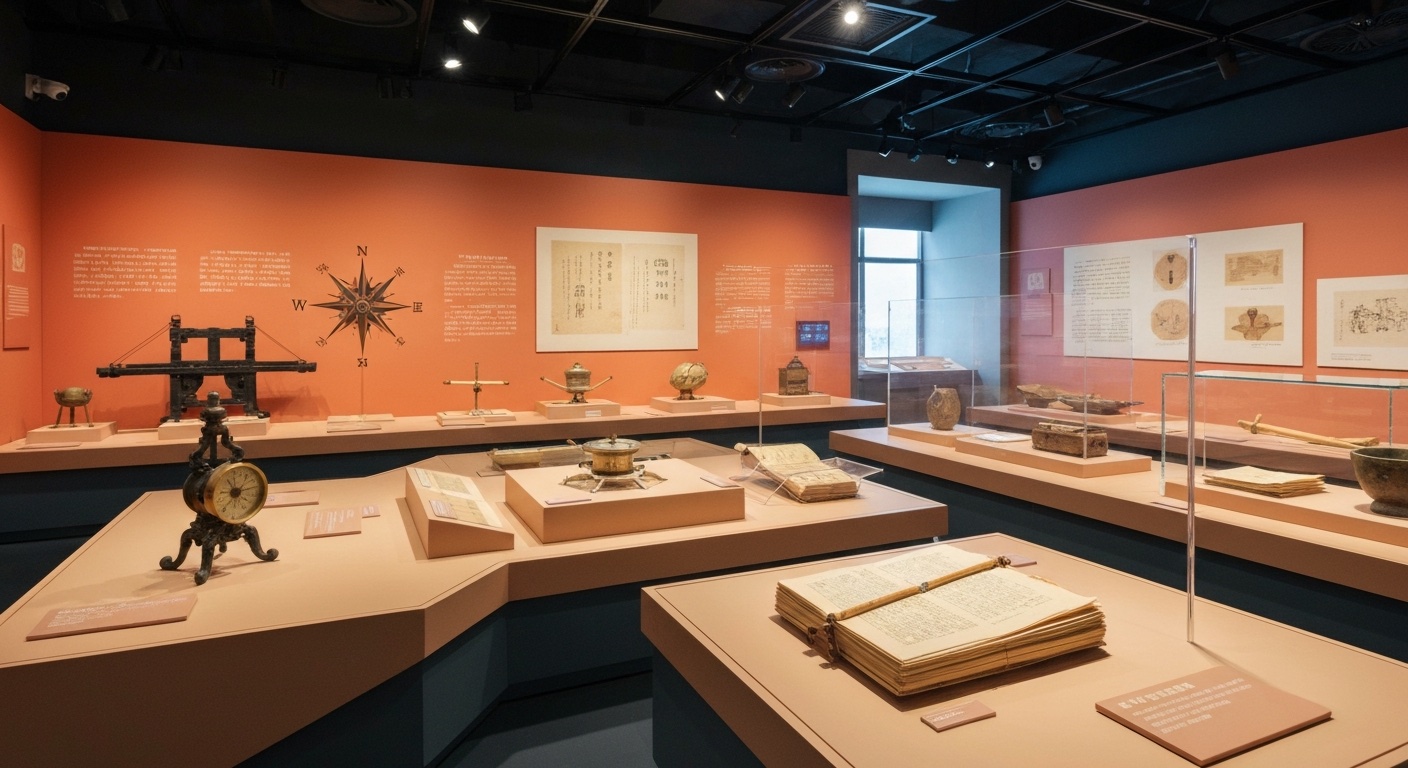
If you think ancient China only invented gunpowder, paper, compass, and printing press, you are overdue for a historical update. Here in Kunshan, I engage daily with high-tech factories, but it is by looking to the past that we understand the magnitude of China's contribution to the modern world. According to the Institute for the History of Natural Sciences of the Chinese Academy of Sciences (中国科学院自然科学史研究所), which cataloged 88 fundamental ancient Chinese inventions, and British researcher Robert Temple, more than half of the technological bases of the contemporary world were established in China before the Common Era. The list ranges from the first functional seismograph to the meritocratic examination system that inspired Western public administration, passing through medical and agricultural techniques that Europe only replicated millennia later.
The Zhang Heng seismograph and the detection of distant earthquakes in 132 AD
The world's first instrument capable of detecting remote seismic tremors was born in China during the Eastern Han Dynasty. Zhang Heng (张衡), a polymath scientist and astronomer, built the 地动仪 (dìdòngyí), or "Earth's movement device," in 132 AD. The device consisted of a bronze container with eight dragon heads positioned at cardinal points, each with a sphere in its mouth. When a seismic wave arrived, a pendulum mechanism made the sphere fall into the mouth of a bronze frog positioned below, indicating the direction of the epicenter.
The effectiveness of the instrument was proven in 138 AD when the seismograph registered an earthquake that occurred in Longxi (now Gansu province), over 600 kilometers from the capital Luoyang. The palace officials did not feel any local tremor and initially doubted the device, but a few days later, a messenger arrived confirming the disaster in the exact direction pointed by the dragon. This feat is documented in the 后汉书 (Hòu Hànshū, or Book of the Later Han), an official historical text compiled in the 5th century. Meanwhile, the West only developed similar instruments in the 18th century.
The connection with Brazil is direct: the SASMEX (Mexican Seismic Alert System), which could be implemented in São Paulo and other Brazilian seismic cities, operates with the same early detection logic that Zhang Heng devised almost two thousand years ago. The difference is that today we use electronic sensors instead of bronze dragons, but the principle of alerting distant populations remains identical.
Smallpox inoculation that inspired the world's first Western vaccination
Long before Edward Jenner developed the smallpox vaccine in 1796, Chinese doctors were already practicing 人痘接种 (réndòu jiēzhǒng), or human smallpox inoculation. The method, documented in medical texts of the Song Dynasty (10th century) and fully established during the Ming Dynasty (16th century), consisted of collecting material from mild pustules of patients and introducing it into the nasal passages or skin of healthy people, inducing a mild form of the disease and generating permanent immunity.
The technique traveled the Silk Road and arrived in Turkey in the 17th century, from where the wife of the British ambassador, Lady Mary Wortley Montagu, brought it to England in 1721. According to records from 新华社 (Xīnhuáshè, Xinhua News Agency), the Chinese practice drastically reduced smallpox mortality centuries before Western medicine adopted the procedure. When Jenner developed his vaccine using the cow virus (vaccinia virus), he was refining a concept of immunization that was already saving lives in China for over eight centuries.
The global impact was immense. The World Health Organization declared smallpox eradicated in 1980, but the basis for this achievement was established by Chinese doctors who understood, through clinical observation, that controlled exposure to the pathogen generated protection. In colonial Brazil, variolation arrived through Portuguese influence, but only became a public health policy in the 19th century, long after it was already a common practice in the Far East.
The Chinese blast furnace and the casting of liquid iron millennia before Europe
In the 5th century BC, during the Warring States Period, Chinese blacksmiths developed the 高炉 (gāolú), or blast furnace, capable of reaching temperatures above 1,150 degrees Celsius. This heat was sufficient to liquefy iron, allowing its casting into complex shapes. In Europe, the same level of technology was only achieved around the 14th century of the Common Era, when the Stückofen blast furnaces began to operate in the Alpine region.
The technological difference was stark. While medieval Europeans were still hammering iron in forges to obtain low-carbon steel, the Chinese were already producing 生铁 (shēngtiě, white cast iron) and 铸铁 (zhùtiě, gray cast iron) on a large scale. This allowed the mass production of plows, hoes, and weapons at much lower costs. Chinese agricultural production was multiplied by cheap and durable tools that simply did not exist in the ancient West.
The technical source of this invention is recorded in the 考工记 (Kǎo Gōng Jì, or Record of Artisans), a text from the Zhou period that describes detailed metallurgical processes. When this technology finally arrived in Europe via the Silk Road and migrations of nomadic peoples, it catalyzed the Agricultural Revolution and, subsequently, the Industrial Revolution. Cheap iron is the backbone of modern industrial civilization, and the Chinese mastered it two thousand years before James Watt invented his steam engine.
The Keju examination system that created the global model of administrative meritocracy
The idea that a public servant should be chosen by knowledge and not by aristocratic birth originated in China with the 科举 (kējǔ) system. Initially created by Emperor Yang Jian of the Sui Dynasty in the 7th century and perfected during the Tang Dynasty, the Keju established provincial, metropolitan, and palace examinations based on mastery of Confucian Classics, poetry, and practical politics. For the first time in world history, a peasant could become the empire's prime minister through study.
This model directly influenced the reform of the British civil service in the 19th century. The Northcote-Trevelyan Report of 1854, which established the public competition system in the United Kingdom, was explicitly inspired by the Chinese system, as documented in British parliamentary records. The British, in turn, exported this model to their colonies, including India, and indirectly influenced public administration in Brazil, where the federal public competition only consolidated with the 1934 Constitution, but remains a direct legacy of this Chinese invention.
The primary historical source is the 新唐书 (Xīn Tángshū, or New Book of Tang), compiled in the 11th century, which details the hierarchical structure of the examinations. The invention of the Keju established the concept of a meritocratic state that we today consider obvious, but at the time was revolutionary compared to the caste and nepotism systems that dominated feudal Europe.
The stern rudder that allowed high-precision ocean navigation
The oldest representation of a 舵 (duò), or stern rudder, appears on funerary ceramics from the Han Dynasty Guangzhou tombs (广州汉墓), dated to the 1st century BC. Unlike the lateral steering oar used by Mediterranean ships, the Chinese stern rudder is installed directly on the central line of the vessel, allowing precise maneuvers even in rough waters and contrary winds.
This invention was crucial for the development of the Maritime Silk Road during the Tang and Song Dynasties. Without the precise directional control that the stern rudder offered, the large Chinese junks would not have been able to cross the Indian Ocean to East Africa in the 15th century, decades before the Portuguese caravels. Europe only adopted this technology around the 12th or 13th century, possibly through contacts with Arab ships that had copied it from the Chinese.
The stern rudder is, therefore, one of the Chinese inventions that shaped the world by making the Age of Exploration possible. Without it, Columbus would not have maintained the constant course necessary to cross the Atlantic. The definitive archaeological source is in the excavation reports of the Han tombs published by the Guangzhou Museum of History, which show ceramic models of ships equipped with sophisticated rudders.
The Zhao Guo seed drill that revolutionized global agriculture
In the 2nd century BC, during the reign of Emperor Wu of Han, the official agronomist Zhao Guo (赵过) invented the 耧车 (lóuchē), an animal-drawn mechanical seed drill. The device, pulled by oxen, opened furrows, deposited seeds, and covered them with soil simultaneously in three parallel lines, precisely controlling the depth of planting. This invention tripled the efficiency of manual planting.
Europe only knew something similar with Jethro Tull's machines in the 18th century of the Common Era, that is, almost two millennia later. The 汉书 (Hànshū, or Book of Han), compiled by historian Ban Gu, describes in detail how the introduction of the lóuchē increased the production of wheat and millet in the northern Chinese plains, preventing famines during periods of drought.
The connection with Brazil is particularly relevant to the São Paulo and Mato Grosso agribusiness sectors. The modern seeders that plant soybeans on a large scale operate with the same mechanical principle established by Zhao Guo: furrow opening, precise seed deposition, and immediate covering. The difference is that today we use GPS and hydraulics, but the concept of mechanized sowing in line is a Chinese invention that fed civilizations for centuries.
The Sichuan Jiaozi and the invention of modern fiat money
In the 11th century, specifically in the year 1023, merchants in Sichuan province, tired of carrying heavy iron coins for commercial transactions, created the 交子 (jiāozǐ), the world's first paper money. Initially issued by private deposit houses and later nationalized by the Northern Song Dynasty government, the Jiaozi was a payment promise backed by metal reserves, exactly the same principle as modern money.
According to the 宋史 (Sòngshǐ, or Book of Song), paper currency circulated for over 400 years in China, going through cycles of inflation and devaluation that reflect contemporary monetary problems. When Marco Polo described this system to Europeans in the 13th century, he was treated as a liar. The West only adopted paper money in the 17th century, in Sweden, and only generalized it in the 19th century.
The invention of the Jiaozi established the basis for the international banking system and the credit economy that moves the world today. From Brazil's Pix digital payments to China's digital Yuan, all operate on financial concepts tested for the first time with the Jiaozi in Chengdu exactly a thousand years ago. The Chinese innovation was not only technological but institutional, creating the necessary confidence for a piece of paper to represent real value.
The moldboard plow that transformed heavy soil agriculture
The 犁壁 (líbì), or moldboard plow, is a curved iron plate attached to the plow that turns the soil upside down during plowing. Developed in China during the Warring States Period (4th century BC), this invention allowed cutting weeds' roots and burying them, as well as bringing nutrients from the subsoil to the surface. It was essential for working the heavy and wet soils of central China.
In Europe, where light Mediterranean terrace soils predominated, this technology only became necessary and was adopted during the 18th-century Agricultural Revolution, particularly in England, with the so-called "Rotherham plough." The two-thousand-year delay in adopting this basic tool limited European agricultural productivity for centuries.
The technical source of this invention appears in the 吕氏春秋 (Lǚshì Chūnqiū), an encyclopedia compiled in the 3rd century BC, which describes the efficiency of iron plows with moldboards. This Chinese invention shaped the world by allowing agricultural expansion into temperate humid regions, precisely the type of climate that predominates in Western Europe and southern Brazil, where today global agro-industrial production is concentrated.
Hua Tuo's surgical anesthesia and complex operations 1,800 years ago
Hua Tuo (华佗), a doctor of the Eastern Han Dynasty who lived between 140 and 208 AD, developed the 麻沸散 (máfèisàn), a mixture of medicinal wine with psychoactive herbs (possibly cannabis and datura) that induced total unconsciousness in the patient. With this anesthesia, Hua Tuo performed complex abdominal surgeries, amputations, and even attempted intestinal repairs, as recorded in his biography in the 后汉书 (Hòu Hànshū).
The West only managed to perform painless operations systematically from 1846, when William Morton demonstrated the use of ether in Boston. During the 1,600 years in between, European surgery was a torment of pain, while in China, although the exact formula of Mafeisan was lost after Hua Tuo's death, the concept of general anesthesia remained in medical literature.
The connection with Brazil can be traced through traditional Chinese medicine (TCM), now regulated in the country. Acupuncture, often associated with TCM in the West, was used by Hua Tuo as a complement to pharmacological anesthesia. The idea that surgery can be painless, today so obvious, was a Chinese intellectual invention that took almost two millennia to be replicated globally.
The high-temperature porcelain that became a synonym for the country itself
The word "porcelain" in English is "china," precisely because this invention defined the country's image abroad. Developed from the 7th century (Tang Dynasty) and perfected in Jingdezhen (景德镇) during the Song Dynasty, true porcelain requires temperatures of 1,300 degrees Celsius to vitrify a specific mixture of kaolin (高岭土 gāolǐngtǔ) and soapstone. The result is a white, translucent, and sonorous ceramic when struck.
According to the 景德镇陶录 (Jǐngdézhèn Táolù, or Record of Jingdezhen Ceramics), compiled in the 18th century, the manufacturing secrets were as valuable as silk. Chinese porcelain dominated global trade through the Maritime Silk Road, reaching Egypt, Persia, and Europe as an unattainable luxury item. Only in the 18th century did the German alchemist Johann Friedrich Böttger manage to reverse-engineer Chinese porcelain technology to found the Meissen manufactory.
The modern ceramic industry, from sanitary ware to high-voltage electrical insulators, derives from this Chinese technology. In Brazil, traditional high-temperature ceramics, such as those produced in Cunha (SP), use techniques that date directly back to Jingdezhen's kilns. The invention was not only artistic; it was a materials engineering achievement that changed the aesthetics and functionality of everyday global objects.
The forensic fingerprint system established in the Tang and Song Dynasties
The last invention on this list is the one you use to unlock your smartphone, but in ancient China, it already served to solve crimes and authenticate contracts. The systematic use of 指纹 (zhǐwén, fingerprints) as legal evidence was born during the Tang Dynasty (7th century), with contractual records showing fingerprints of illiterate parties, and was formalized as a forensic technique during the Song Dynasty (13th century).
The book 洗冤集录 (Xǐ Yuān Jí Lù, or Collection for the Elimination of Judicial Errors), written by Song Ci in 1247, describes methods for identifying crime suspects through the analysis of fingerprints left at homicide scenes. In Europe, dactyloscopic identification only became precise science in 1892, with Francis Galton, and was implemented by Scotland Yard in 1901. The Chinese anticipated this police technology by over 600 years.
Sources such as the 唐律疏议 (Tánglǜ Shūyì, Commentary on the Tang Penal Code) show that fingerprints were considered undeniable evidence in property disputes. This Chinese invention shaped the world by establishing the basis of modern biometrics, today used in electronic passports, banking systems, and global digital security. When you place your finger on your phone reader, you are using a technology that the Chinese invented to sign land lease contracts in 650 AD.