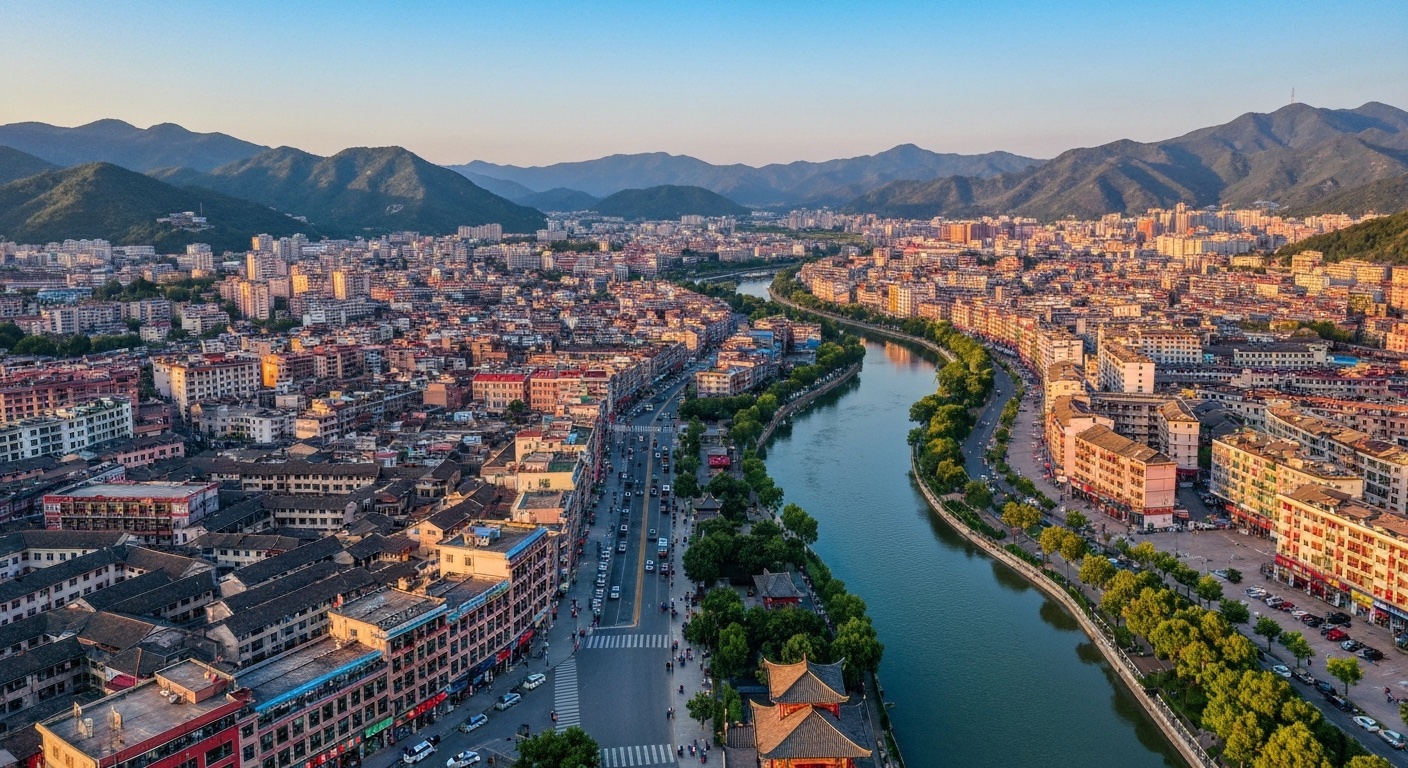
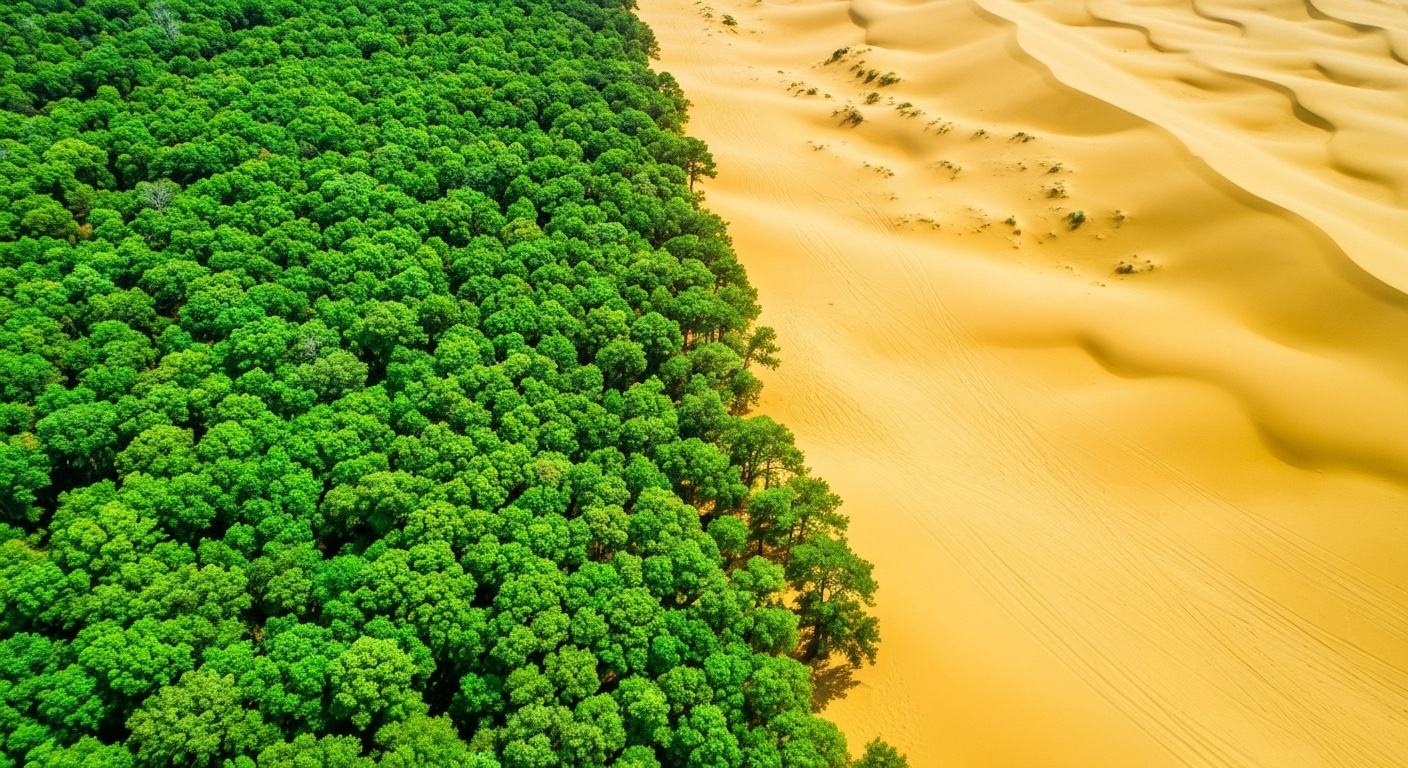
In 1978, northern China was suffocating. Sandstorms swept through Beijing so frequently that residents had to cover their faces with cloths to leave their homes. The Gobi Desert was advancing at a rate of about 3,600 km² per year — an area larger than the city of São Paulo being swallowed by sand every twelve months. Entire villages were abandoned. Pastures that had sustained generations of families turned into sterile dunes.
It was against this backdrop that the Chinese government launched what would become the largest afforestation project in human history: the Three-North Shelterbelt Program, known worldwide as the Great Green Wall of China.
A 73-year project
The program was conceived in 1978 with an ambition that seemed delusional: to create a 4,800 km-long forest barrier covering the north, northeast, and northwest of the country. The completion deadline? 2050. In other words, a project designed to span three generations.
The scale is hard to grasp. The planned protection belt covers 42% of Chinese territory — an area of 4.1 million km², nearly half of all of Brazil. The goal was not just to plant trees, but to rebuild ecosystems degraded by centuries of overgrazing, predatory agriculture, and firewood extraction.
From the start, the program was divided into three phases. The first (1978–2000) focused on stabilizing the most critical areas of desertification. The second (2001–2020) expanded coverage and diversified species. The third and current phase (2021–2050) aims to consolidate results and make ecosystems self-sustaining.
By the end of 2023, China had planted more than 78 billion trees across all its combined afforestation programs. The Great Green Wall alone accounts for a huge portion of that number: about 66 million hectares reforested — an area equivalent to France.
What the satellites show
If there is undeniable proof that the program works, it comes from space. In 2019, a study published by NASA using MODIS satellite data revealed that China and India were responsible for a third of the global increase in green areas recorded since 2000. China alone contributed 25% of that growth — and most of it came from planted forests, not natural regeneration.
The before-and-after images are stunning. Regions of the Loess Plateau, which in the 1990s appeared on satellite maps as brown and yellow patches, now show a dense, continuous green. The contrast is so stark it has become study material at universities worldwide.
Data from the European Space Agency's Copernicus program confirmed in 2022 that the rate of desertification in northern China has consistently fallen over the last two decades. Areas that were losing vegetation each year have now begun to gain stable green coverage.
This doesn't mean everything is rosy — literally. Many of the trees planted in the first decades were monocultures of fast-growing species like the poplar (Populus), which do not form resilient ecosystems. A significant portion of these initial plantations died from lack of water or pests. The survival rate in some regions fell below 30%. But the program learned from its mistakes, and more recent phases have prioritized native species and biodiversity.
Kubuqi: the desert that became an oasis
If the Great Green Wall is the program, the Kubuqi Desert is its poster child. Located in Inner Mongolia, Kubuqi was China's seventh-largest desert, with 18,600 km² of dunes threatening to swallow nearby cities and silt up the Yellow River.
Kubuqi's transformation began in the 1980s, but gained scale in the 2000s with a combination of public and private investment. The Elion Resources Group, founded by Wang Wenbiao, a local businessman who grew up in the desert, invested billions of yuan in sand-control technologies and planting.
One of the most ingenious techniques was the use of straw panels driven into the sand in a grid pattern. These panels reduce wind speed at the surface and create microenvironments where seeds can germinate. Over time, ground vegetation stabilizes the soil and allows for the planting of shrubs and trees.
Kubuqi's numbers speak for themselves: more than 6,000 km² of desert have been reclaimed — a third of its total area. The local residents' per capita income jumped from less than 400 yuan per year in the 1990s to over 14,000 yuan in 2020. What was one of China's poorest places has become a UN-recognized model for sustainable development.
In 2017, the UN awarded the Kubuqi project the "Champions of the Earth" award in the Inspiration and Action category. The desert began receiving delegations from dozens of countries wanting to understand how to replicate the model.
The controversial side
It would be naive to present the Great Green Wall as an unqualified success without nuance. The program has serious critics, and those criticisms deserve attention.
First, the water issue. Planting billions of trees in arid and semi-arid regions consumes enormous amounts of groundwater. Researchers from Peking University have published studies showing that in some areas of the northwest, the water table has dropped alarmingly after mass afforestation. Trees meant to protect against drought can, paradoxically, worsen it.
Second, monoculture. As mentioned, the first decades of the program planted vast areas with only one or two species. This created forests vulnerable to pests and fires. In 2000, a moth plague devastated entire poplar plantations in Ningxia province. The lesson was painful but necessary.
Third, there is the issue of forced relocations. To protect afforestation areas, the government relocated thousands of herders and farmers, not always with adequate compensation. Nomadic communities in Inner Mongolia reported a loss of cultural identity and difficulty adapting to urban life.
Fourth, the accounting. Some international researchers question China's official figures, arguing that the definition of "reforested area" used by China includes commercial plantations and low shrubs that do not function as a barrier against desertification. The actual data on effective forest coverage would be lower than reported.
These criticisms do not invalidate the program. They show that projects of this scale are necessarily imperfect and require constant correction — something, it must be said, the program has been doing.
Sandstorms: before and after
For those living in Beijing in the 1990s and 2000s, sandstorms were part of the calendar. Every March and April, the capital's sky turned yellow-orange, visibility dropped to a few meters, and hospitals were flooded with cases of respiratory problems.
Data from the China Meteorological Service shows a drastic drop: in the 1950s, the country recorded an average of 26 sandstorm days per year. In the 2010s, that number fell to less than 6. In 2020, only 3 days were recorded.
This is not solely the merit of the Great Green Wall — changes in wind patterns and reduced grazing also contributed. But the forest barrier is consistently cited as the main factor by Chinese and international researchers.
In 2023, however, Beijing faced a severe sandstorm that recalled the worst episodes of the 2000s. The event generated headlines like "the green wall failed?", but experts explained it was an atypical combination of climatic factors, not a reversal of the long-term trend. The overall frequency continues to fall.
What Brazil can learn
Brazil faces different challenges, but the underlying logic is the same: large-scale environmental degradation requires a large-scale response, sustained for decades, not just election cycles.
Brazil's Cerrado is losing native vegetation at an alarming rate — more than 10,000 km² per year in the worst recent periods. The Amazon, despite the slowdown in deforestation in 2023, still faces constant pressure from land grabbing, illegal mining, and extensive cattle ranching. The northeastern semi-arid region deals with desertification processes affecting millions of people.
From the Chinese experience, three lessons stand out:
Long-term horizon. The Great Green Wall was planned for 73 years. In Brazil, environmental policies rarely survive a change of government. The Plan of Action for the Prevention and Control of Deforestation in the Amazon (PPCDAm), for example, was effective between 2004 and 2012, but was virtually abandoned between 2019 and 2022. Environmental projects need institutional shielding against political volatility.
Combination of public and private. Kubuqi showed that involving the private sector is not optional — it's essential. When companies find viable business models in environmental restoration (solar energy in reclaimed desert, eco-tourism, sustainable agriculture), the project takes on a life of its own and doesn't depend solely on public funding.
Learn from mistakes without abandoning the program. China planted the wrong trees, in the wrong places, with the wrong methods — and corrected them. In Brazil, the tendency is to use mistakes as a justification to give up. If a forest restoration program has problems, it needs to be adjusted, not discarded.
There is also a little-explored direct parallel: the African Great Green Wall, a project of the African Union launched in 2007 to contain the advance of the Sahara, was directly inspired by the Chinese experience. Brazil could seek technical cooperation with both China and African countries that are already adapting these techniques to tropical contexts.
The future of the wall
The program remains active and expanding. In 2024, President Xi Jinping reaffirmed the commitment to increase China's forest coverage from 24% to 26% by 2030 and to over 30% by 2050. New technologies are being incorporated: drones that fire seed capsules into hard-to-reach areas, IoT-connected soil sensors to monitor moisture in real time, and artificial intelligence models to predict desertification patterns.
The challenge now is different from what it was in 1978. It's no longer about planting on virgin land — it's keeping what was planted alive in the context of accelerating climate change. Higher temperatures and more irregular rainfall in northern China threaten some of the gains of the last few decades.
But the fact remains: a country that was losing territory to the desert every year managed to reverse the trend in less than half a century. Not with miraculous technology, not with a magical solution — but with persistent planting, correcting mistakes, and long-term commitment.
Perhaps that is the simplest and most difficult lesson of all: there is no shortcut to restoring the environment. There is continuous work, measured in decades, done by millions of hands.
To follow more stories about how China is changing — on the environment, technology, and society — keep watching chinato.watch.
Publication sources
- China and India Lead in Greening of the World Through Land-Use Management ↗
- Three-North Shelter Forest Program — China's Green Great Wall ↗
- Kubuqi Desert Ecological Restoration — UN Champions of the Earth ↗
- Desertification and Sand Storm Trends in Northern China ↗
- Copernicus Global Land Service — Vegetation Monitoring ↗