One terawatt of sun: China crosses the historical barrier
In May 2025, China became the first country on the planet to surpass 1,000 gigawatts (1 terawatt) of installed photovoltaic capacity. Just a month later, in June, the figure already exceeded 1,100 GW. For perspective: this is more than the entire combined solar capacity of Europe, the United States, India, and Japan.
The milestone did not come out of nowhere. In 2024 alone, the country added 277 GW of solar energy — equivalent to 15% of the world's entire accumulated solar capacity. No other country came close: the United States installed about 35 GW in the same year, and the entire continent of Europe summed up approximately 65 GW.
These figures mean China accounts for more than one-third of the world's installed solar capacity. And the trajectory shows no signs of slowing down.
The ascent: from 80 MW to 1 terawatt in two decades
The story of Chinese solar energy begins in the semiconductor laboratories of the 1950s, when researchers produced the country's first piece of monocrystalline silicon. For decades, the technology served almost exclusively military and civil satellites.
The leap came in the 2000s. In 2006, China had a mere 80 MW of total solar capacity. Starting in 2011, the government introduced feed-in tariffs (guaranteed prices for those who generated solar energy) that transformed the sector. By 2013, China was already the world's largest installer of panels. In 2015, it surpassed Germany as the largest producer of photovoltaic energy. In 2017, it was the first country to surpass 100 GW installed.
The progression in the following years was exponential:
- 2019: 205 GW accumulated
- 2020: 253 GW
- 2022: 393 GW
- 2023: ~610 GW
- 2024: ~887 GW (after a record addition of 277 GW)
- May 2025: 1,000 GW (1 TW)
- June 2025: 1,100 GW
The goal announced by Xi Jinping at the 2020 Climate Ambition Summit was to reach 1,200 GW of combined solar and wind capacity by 2030. China hit that target in 2024 — six years ahead of schedule.
Why China installs more than the rest of the world combined
Three factors explain China's dominance in the solar sector: industrial policy, production scale, and cost.
Continuous industrial policy. Since the Sixth Five-Year Plan (1981-1985), every Chinese five-year plan has included targets and incentives for the manufacturing of solar panels. After the 2008 financial crisis, the government offered cheap land, tax incentives, and subsidized loans to save the photovoltaic industry. When Europe and the U.S. imposed anti-dumping tariffs in 2011-2012 and companies like Suntech Power went bankrupt, Beijing responded by creating a gigantic domestic market.
A scale that no one else can match. Chinese companies dominate all stages of the production chain: polysilicon, silicon wafers, photovoltaic cells, and solar modules. This vertical integration allows for aggressive cost reduction. China produces more than 80% of the world's solar panels.
The cost has plummeted. Since at least 2023, solar energy has been cheaper than coal-fired energy in China. The price of photovoltaic modules has fallen by more than 90% since 2010 — and much of this decline is due to the scale of Chinese production. In 2025, high-efficiency solar panels cost less than US$ 0.10 per watt in the Chinese market.
LONGi, JA Solar, Trina: the giants that dominate the global market
Three Chinese companies stand out as pillars of the global solar industry.
LONGi Green Energy, founded in 2000 in Xi'an, is the world's largest manufacturer of monocrystalline silicon wafers. The company has become a benchmark in efficiency, breaking world records for solar cell conversion three times in five months. LONGi operates factories in China, Malaysia, and Vietnam, and its modules equip projects in more than 150 countries. In 2024, the company announced a restructuring with a 30% reduction in its workforce, a reflection of the price war that has hit the sector — but it maintained its technology leadership.
JA Solar, founded in 2005 in Beijing, sells to 178 countries and regions. The company is one of the world's largest manufacturers of photovoltaic cells and modules, with a strong presence in Europe, South Korea, and Latin America. Listed on the Shenzhen Stock Exchange, JA Solar has aggressively expanded its production capacity in the last five years.
Trina Solar, founded in 1997 in Changzhou, recorded revenue of US$ 11.27 billion in 2024 and employs more than 30,000 people. Listed on the Shanghai Stock Exchange, Trina has a strong presence in Brazil and the Caribbean. "When we arrived in the country, the market was relatively small. Now it is one of the largest in the world," said Álvaro García-Maltrás, Trina's vice president for the Caribbean and Latin America.
Other relevant manufacturers include Canadian Solar (founded by a Chinese national in Canada, with majority production in China), Jinko Solar, and Risen Energy. Together, the top five Chinese manufacturers account for more than half of all solar modules sold on the planet. It is a market concentration without parallel in any other energy sector.
The Gobi Desert becomes a power plant: China's solar megaprojects
A large part of China's solar expansion is taking place in the vast desert regions of the west of the country. The Gobi Desert, the Tarim Basin in Xinjiang, and the Qinghai Plateau are home to some of the largest solar parks ever built.
The Tengger Desert Solar Park, in Inner Mongolia, has a capacity of 1.5 GW and was once the world's largest solar park when it was inaugurated in 2018. The Huanghe Hydropower Hainan Solar Park, in Qinghai, has 2.2 GW — currently the second largest on the planet.
In 2023, China inaugurated the world's largest hydro-solar power plant in Sichuan, which combines hydropower generation with photovoltaic panels. The stability of hydropower compensates for the variability of solar energy, creating a more reliable system.
These desert projects are part of a larger strategy: generating energy in the western provinces and transmitting it to consumption centers in the east. Ultra-high voltage (UHV) transmission lines cross thousands of kilometers to connect the Gobi to Shanghai, Guangzhou, and Beijing. The State Grid Corporation, the state-owned entity responsible for the electrical grid, already operates more than 30 UHV lines — an infrastructure that no other country has on a comparable scale. It is this combination of cheap desert generation and long-distance transmission that makes the Chinese solar model unique.
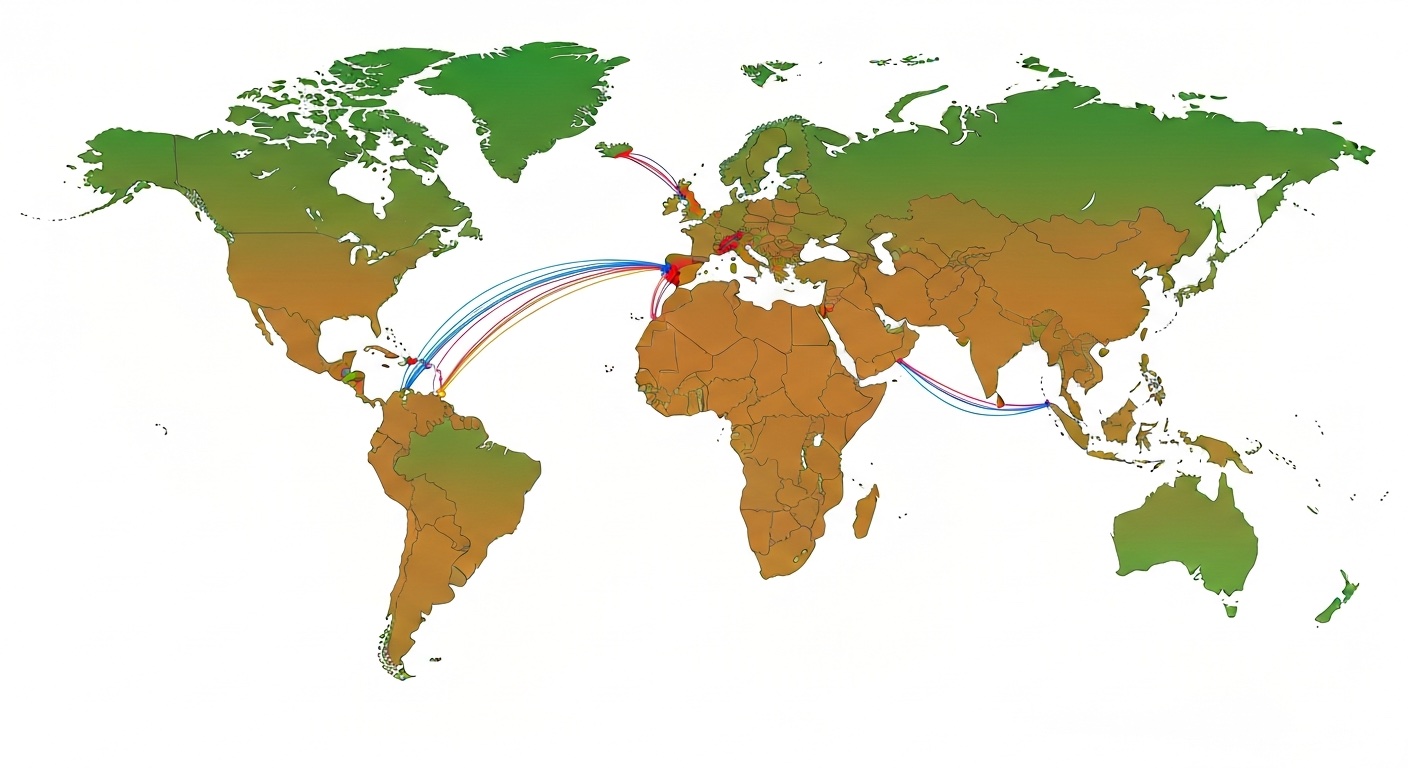
Brazil on the route of Chinese panels
Brazil is one of the largest markets for Chinese solar panels outside of Asia. With 53.9 GW of installed solar capacity in February 2025, the country is already the 5th largest in the world in solar energy — and most of the modules come from China.
The connection is direct. In 2020, LONGi signed a contract to supply 908 MW of solar modules to Brazil. Trina Solar has consolidated operations in the country and participates in energy auctions. The Chinese manufacturer Chint announced plans to build a panel factory in Rio Grande do Norte. Canadian Solar has operated a factory in Sorocaba (SP) since 2016, with an annual capacity of 400 MW.
For Brazil, the drop in Chinese panel prices was decisive. The country jumped from less than 1 GW installed in 2017 to nearly 54 GW in 2025, driven by modules imported at ever-lower prices. Solar energy already accounts for about 10% of Brazilian electricity generation and 21.9% of the installed capacity matrix. The distributed generation market — small panels on the roofs of homes and businesses — grew the most, with Minas Gerais, São Paulo, and Rio Grande do Sul leading residential installations.
This dependence, however, raises questions. Potential commercial tariffs, geopolitical disputes, or logistical problems could affect the supply. For now, the partnership works: China provides the cheap technology, and Brazil offers one of the best solar radiation indices in the world (4.25 to 6.5 hours of sun per day).
The cost curve that changed everything
The Chinese solar revolution is not just about gigawatts — it's about the price. The drop in the cost of solar energy is one of the most impressive economic stories of the last two decades.
In 2010, the cost of a solar module was about US$ 2 per watt. In 2020, it fell to US$ 0.20. In 2025, modules in the Chinese market cost less than US$ 0.10 per watt. This drop of more than 95% has made solar energy the cheapest source of electricity in history in many parts of the world.
China is responsible for most of this reduction. By building factories on a gigantic scale, investing heavily in R&D, and accepting minimal profit margins (or even temporary losses), Chinese companies forced prices down in a way that no competitor could match.
The result is paradoxical: the Chinese solar industry is facing a profitability crisis — LONGi cut 30% of its employees in 2024, and several smaller manufacturers closed — but the world benefits from incredibly cheap solar panels. It is creative destruction on a planetary scale.
Wind and sun: the goal that arrived too early
The combined goal of 1,200 GW of solar and wind by 2030, announced by Xi Jinping in 2020, was considered ambitious at the time. China achieved it in 2024, six years ahead of schedule.
In April 2025, combined wind and solar energy surpassed, for the first time, a quarter of all electricity generation in China. It is a structural transformation: the world's second-largest economy is slowly reducing its dependence on coal — although coal continues to dominate the total energy matrix.
The challenge now is different: integrating all this capacity into the electrical system. The intermittency of solar energy (which only generates during the day) requires massive investments in energy storage, smart grids, and transmission lines. China also faces the problem of the "solar curtain" — energy produced in excess during peak solar hours that cannot be absorbed by the grid.
What the numbers say about the future
If China maintains the 2024 pace (277 GW/year), it will have 2 terawatts of installed solar capacity before 2030. Even with a slowdown, the 1.5 TW barrier should be reached by 2027.
For the rest of the world, the message is clear: the solar energy transition is happening, and China is at its center — as the largest installer, largest manufacturer, and largest exporter of panels. The country not only installed more solar capacity in 2024 than the rest of the world combined: it also manufactured the panels that the rest of the world installed. Countries like Brazil, which import most of their modules from China, benefit directly from this scale.
Debates about technological dependence, labor practices, and government subsidies are legitimate and important. But the numbers are indisputable: China has installed more solar panels in the world than any other country could have dreamed of — and it is just getting started.
Follow the real China. China to Watch brings unfiltered analysis on Chinese economy, technology, and geopolitics. Explore our articles and understand the country that is redrawing the planet's energy map.