11 facts about clean energy in China that the Western media prefers to ignore
China installs more solar energy than the rest of the world combined. It has the largest EV charging network. And it leads in next-generation nuclear. The numbers.
Phelipe Xavier
Creator of China to Watch · lives in China · February 20, 2026 · 9 min read
China installed more solar panels in six months than the rest of the world combined
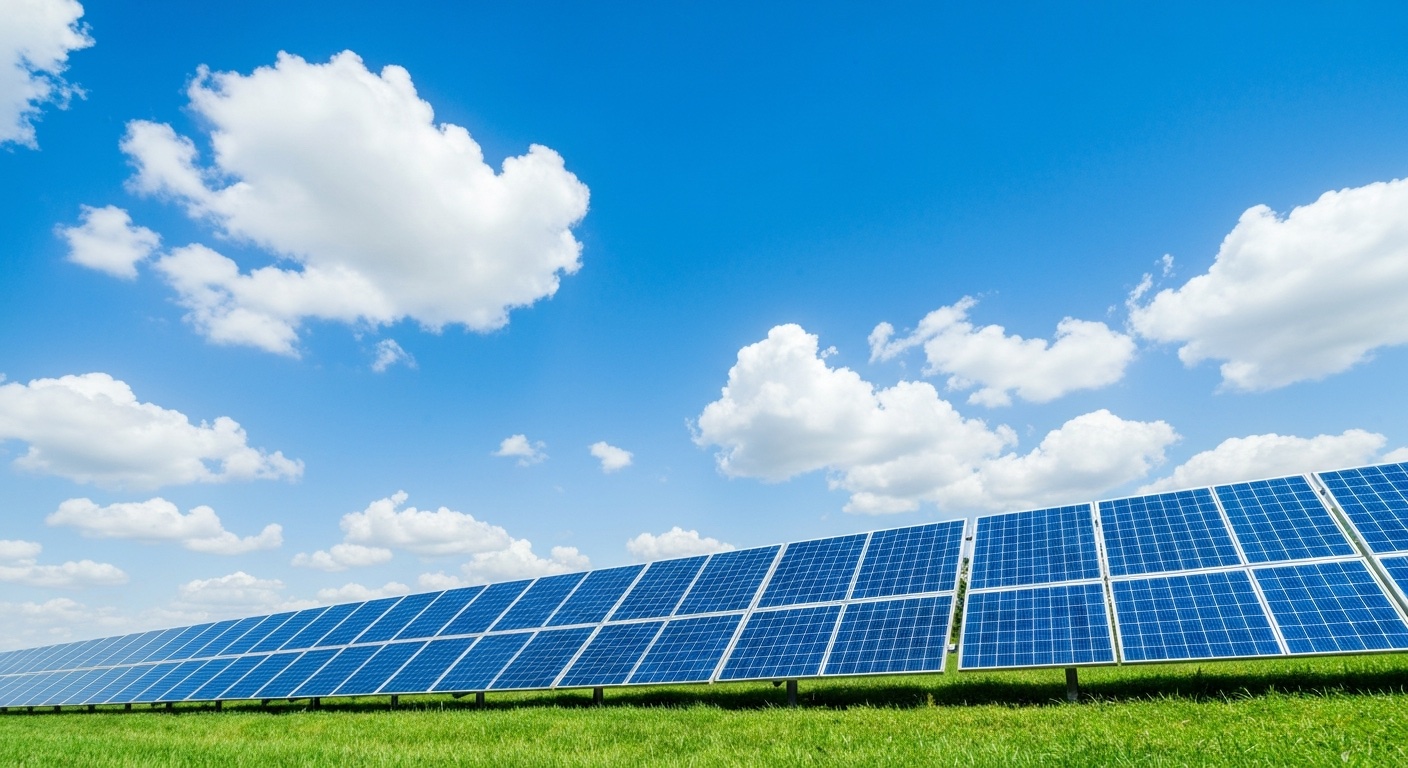
In the first half of 2025, solar generation in China grew by 43% compared to the previous year. This number not only exceeded the global average of 31% but also represented alone 55% of all global solar growth during the period. According to the report 2025 Global Power Mid-Year Insights, cited by the portal 新浪财经 (Sina Finance), Chinese expansion in the photovoltaic sector was greater than the sum of installations of all other countries together.
The same report shows that wind energy also skyrocketed by 16% in the country, double the global average and equivalent to 82% of global wind generation growth. These two data together explain why, for the first time in history, renewables generated more electricity than coal in the first half of this year. The transition is not a promise for 2050. It is happening now, in 2025, as you read this.
China's clean energy production chain controls over 70% of the global market
It's no use wanting to do solar energy if there are no panels. And panels, in today's world, go through China. According to a report by 新华社 (Xinhua) reproduced by 新浪新闻 (Sina News), the country has built the most complete and largest clean energy industrial chain on the planet. Photovoltaic and wind equipment manufactured in China account for over 70% of the global market.
This dominance is not just quantitative. The same source highlights technical advances such as the quantum-based solar-hydrogen co-generation system, which achieves 68% conversion efficiency. This is a technological leap that allows the direct production of green hydrogen from sunlight with an utilization rate that was previously impossible. When Westerners talk about "dependence on China for clean energy," they forget that this dependence exists because no one else can manufacture as cheaply, as quickly, and as efficiently.
The country is the world's largest hydrogen producer — and starts betting on green
China is, by far, the world's largest hydrogen producer, with about 33 million tons per year — approximately one-third of global production. Most of it is still gray hydrogen, produced from fossil fuels. Green hydrogen (produced with renewable energy) still represents a small fraction — about 1 million tons globally — but China is heavily investing to change this proportion.
Here in Kunshan, I see fuel cell trucks moving between factories. The local government subsidized green hydrogen refueling stations that use solar energy from the province of Jiangsu itself. The project is not a pilot. It is industrial scale. While Europeans discuss carbon rates at the border, the Chinese have already solved the raw material problem for decarbonizing heavy industry.
Electric vehicles and charging infrastructure create an unprecedented ecosystem
China sells more electric cars in a quarter than Brazil sells combustion cars in a year. According to data from 网易 (163.com) based on information from the 国家发展改革委 (National Development and Reform Commission), the annual production and sale of new energy vehicles (新能源汽车 xīn néngyuán qìchē) exceeded 12 million units in 2024, keeping the country in global leadership for the tenth consecutive season.
But the data that impresses the most is the infrastructure. The site 汽车之家 (Autohome) records that, by 2023, the country had more than 9.58 million public and private chargers. Three companies dominate the market: 特来电 (Teld), 星星充电 (Star Charge), and 云快充 (Yun Kuai Chong), which together hold 52.16% of the sector. In addition, the model of 换电站 (huàn diàn zhàn), stations where the driver swaps a discharged battery for a full one in three minutes, is growing at an accelerated pace. It is an ecosystem that makes the electric car viable even for those who live in apartments without a garage.
The Chinese electricity matrix already has more renewable capacity than thermal
In 2023, for the first time, the installed capacity of renewable sources surpassed that of fossil fuels in China. Data from the portal 太平洋汽车网 (PCAuto), citing the Center for Energy and Clean Air (CREA), show that 50.4% of the total generation capacity was renewable, compared to 47.6% fossil. The rest, about 3%, was nuclear.
Moving on to 2025, the proportion of clean electricity (clean including nuclear, solar, wind, and biomass) already reaches 42% of total generation, causing fossils to fall below 60% of the matrix for the first time, according to 新浪财经 (Sina Finance). This means that each new iPhone factory or electric car factory that opens in Shenzhen or Chengdu is more likely to use clean energy than dirty. The peak of emissions, promised for 2030 in the 碳达峰 (tàn dáfēng) plan, is already visibly on the horizon.
One in every two nuclear reactors under construction in the world is being built in China
Nuclear energy is controversial, but undoubtedly clean in terms of carbon. And China is the most active nuclear construction site on the planet. Data from 2018 from 新浪财经 (Sina Finance) already indicated that 40% of globally under-construction reactors were in the country. Today, the situation remains: Chinese nuclear expansion continues to represent the largest part of global sector growth.
In the first half of 2025, Chinese nuclear generation grew by 11%, accounting for more than 70% of the global increase in atomic electricity, according to the 2025 Global Power Mid-Year Insights report cited by 搜狐 (Sohu). The difference for the West is striking. While Germany shuts down its power plants and the US faces decades of delays in construction, China connects new reactors to the power grid every few months. The technology 华龙一号 (Hualong One), a domestic third-generation reactor, already operates in Fujian and is being exported to countries like Pakistan and Argentina.
China's clean energy technology exports exceeded 180 billion dollars
The Chinese green transition is not just domestic. It is a global business. In the first ten months of 2025, Chinese clean technology exports exceeded 180 billion dollars, according to data from 新浪财经 (Sina Finance). The value includes battery storage systems, electric vehicles, and high-voltage transmission equipment.
This places China in the position of an indispensable supplier of global decarbonization. When Brazil installs solar panels in Minas Gerais or when Germany builds offshore wind parks, much of the components come from factories in Shanghai or Suzhou. The irony is that, at the same time as Europe criticizes the Chinese carbon footprint, it depends on the country's industrial capacity to meet its own climate goals. The data does not lie: without China, the global energy transition simply would not have spare parts.
The clean energy sector in China accounts for 40% of national economic growth
Here is a number that debunks the myth that a green economy is synonymous with recession. In 2023, the clean energy sector represented 40% of Chinese GDP growth, according to the Center for Energy and Clean Air (CREA) cited by 太平洋汽车网 (PCAuto). Investment in renewable infrastructure reached 890 billion dollars that year.
This means that when the Chinese economy grows, almost half of that growth comes from installing panels, wind turbines, battery factories, and smart transmission networks. It is not fossil fuel pulling the line. It is photovoltaic 光伏 (guāngfú) and wind 风电 (fēngdiàn). For a Brazilian used to seeing news that "China only grows by polluting," this data changes the perspective. The growth engine has already changed fuel.
Chinese reforestation absorbs 1.2 billion tons of CO2 annually
China not only cuts emissions. It also removes carbon from the atmosphere on an industrial scale. According to a report by 网易 (163.com) with official data, the country has accumulated 8003万公顷 (80.03 million hectares) of reforestation. These forests capture more than 1.2 billion tons of CO2 per year.
The data is even more impressive when you know that China contributes to a quarter of all new green area in the world since the year 2000. The 植树造林 (zhí shù zào lín), tree planting, program is a state policy since the 1990s, but it gained new strength with the 碳中和 (tàn zhōnghé), carbon neutrality, targets promised for 2060. Here in Kunshan, entire mountains that were abandoned quarries ten years ago are now forests of ginkgo and cedars. It's not greenwashing. It is ecosystem engineering on a continental scale.
The battery swap model creates a real alternative to traditional charging
While in Brazil we debate whether we will have enough energy to charge electric cars at home, China has already tested and approved an alternative model: swapping the entire battery instead of charging it. Data from 汽车之家 (Autohome) shows that 换电 (huàn diàn) stations, or battery swap stations, are increasing in number and are concentrated in high-demand regions.
Companies like NIO already allow the driver to swap a discharged battery for a full one in less time than refueling with gasoline. The system works like a "swap" of cooking gas, but for vehicles. This eliminates range anxiety and the need for parking lots with outlets. For dense cities like São Paulo or Recife, where most people live in old apartments without adequate electrical infrastructure, this Chinese model could be the missing solution for electric mobility to take off.
The transition to clean energy in China avoided 46 million tons of CO2 in just six months
The practical result of all this expansion appears in actual emissions. In the first half of 2025, while renewable capacity grew, thermal generation from fossil fuels fell. The net result was a reduction of 46 million tons of CO2 in the atmosphere, according to calculations from the 2025 Global Power Mid-Year Insights report published on 搜狐 (Sohu).
This number is equivalent to taking ten million cars off the streets for a year. And it happened in just six months, in the world's largest industrial country. The message is clear: when China decides to do something, it does it on a scale that literally changes the global climate. The West can continue to criticize the carbonized past of the Asian giant. But the 2025 numbers show that the future of clean energy inevitably passes through Beijing. And that future has already begun.
We store your visit source locally. Data leaves only if you subscribe to the newsletter. Accepting enables anonymous metrics with no external tracking.