The world's most-watched TV show — and you've probably never heard of it
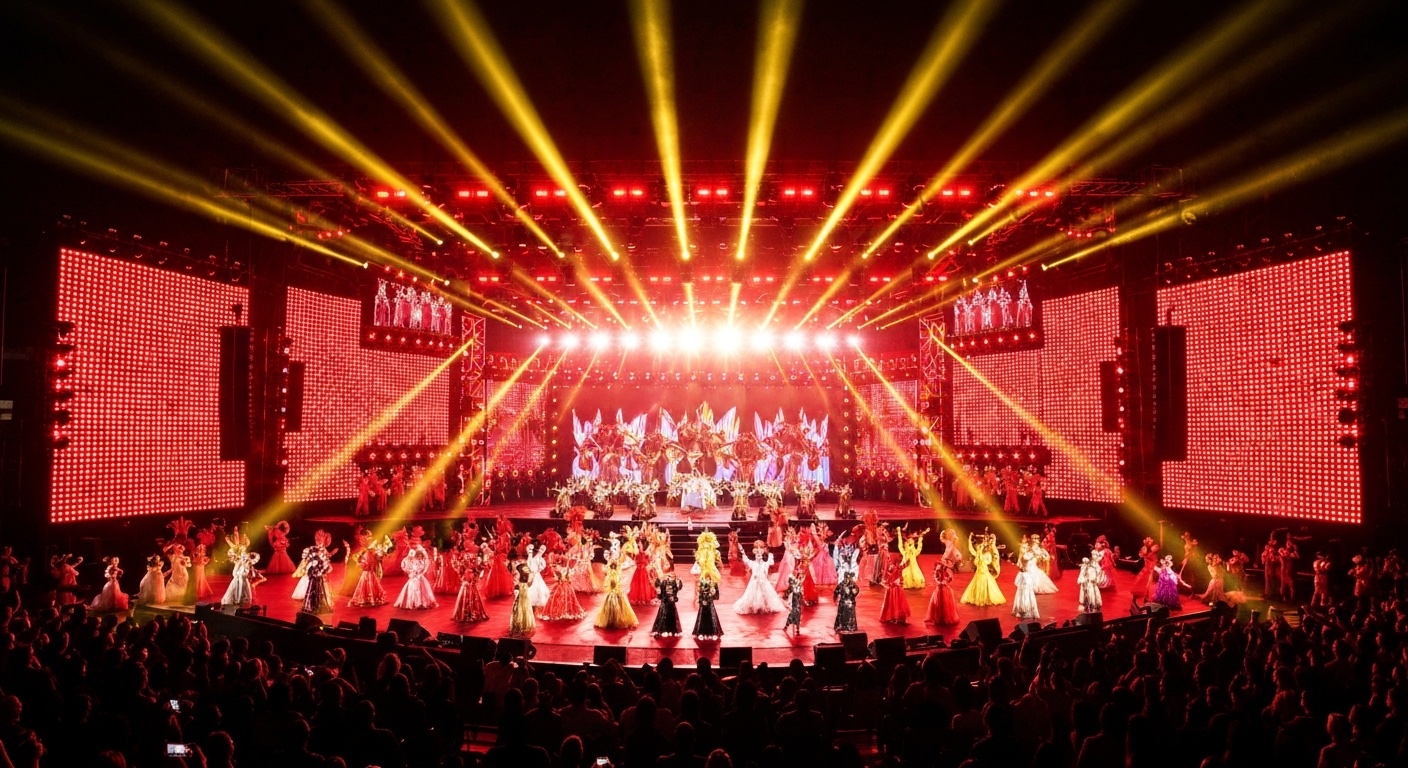
Every year, on the eve of Chinese New Year, something happens that makes the Super Bowl look like a neighborhood party. The CMG Spring Festival Gala — popularly known as Chunwan (春晚) — draws an audience that no other television program in the world can match. The 2018 edition attracted more than 1 billion viewers, according to the show's producers. Guinness World Records recognizes the Gala as the most-watched television program on the planet.
Broadcast continuously since February 1983, the Gala lasts about 270 minutes and mixes music, dance, comedy and drama in a variety show format. For hundreds of millions of Chinese families — including the diaspora spread around the world — watching the show while making jiaozi (dumplings) is a ritual as deeply ingrained as the holiday itself.
But reducing the Gala to "entertainment" is missing the point. If you want to understand where China is headed, pay attention to what appears on that stage.
From improvised party to instrument of State
The first Gala, in 1983, was a low-budget experiment. Director Huang Yihe had a 600-square-meter studio, 60 staff, 200 guests, and no money for recording. The show aired live, improvised, with four telephones taking requests from viewers in real time. Singer Li Guyi closed the night with nine performances — including the song "Hometown Love" (乡恋), which was officially banned at the time for being considered "spiritual pollution" by Party hardliners.
The success was immediate. By 1984, the show had become a political instrument: while China and the United Kingdom were negotiating Hong Kong's future in the Sino-British Declaration, Huang convinced authorities to allow amateur Hong Kong singer Cheung Ming-man to perform the patriotic "My Chinese Heart" (我的中国心). It was the first time a Hong Kong artist had appeared on Chinese television. The message was clear: Hong Kong is China.
From the 1990s onward, the political component became structural. As viewership grew, the State increased its control over production. Entire segments began celebrating the previous year's "national achievements" and previewing significant events of the year ahead. In 2008, according to state media, senior officials from the Communist Party's Publicity Department and the State Administration of Radio, Film and Television were present during rehearsals to supervise production.
The Takungpao newspaper summarized the trajectory: the Gala evolved from a "year-end party" into a "political propaganda dissemination conference."
Leaders on stage: the Gala as a barometer of power
The relationship between the Gala and Party leadership has a revealing history. In 1990, General Secretary Jiang Zemin and Premier Li Peng appeared live on the program — the only six minutes in the Gala's history in which national leaders participated directly in the broadcast.
From the 1990s onward, video montages of Party leaders — from Mao Zedong to Hu Jintao — became a permanent fixture. In 2007 and 2008, the program displayed the full membership of the Politburo Standing Committee. Between 2011 and 2014, those images were removed and the political content fluctuated.
But in 2014, the Gala returned in full force under the Xi Jinping era. The program extensively celebrated the ideology of the "Chinese Dream" (中国梦). In 2015, in a break with tradition, Xi Jinping appeared alone in a long video montage during an opera-style song titled "Give My Heart to You" — something unprecedented in the show's history. Three comedy sketches in that edition made direct reference to Xi's anti-corruption campaign.
The 2016 edition was considered one of the most political since the show's creation. Since 2017, however, the Gala stopped displaying images of national leaders, opting instead for showcases of economic development and nationalist themes. The change does not represent less control — it represents a sophistication in communication methods.
2025: Unitree robots and the signal the world almost missed
At the 2025 Chinese New Year Gala (Year of the Snake), the moment that went viral globally was neither a song nor a joke. It was the entrance of dozens of Unitree Robotics humanoid robots dancing on stage with millimeter-perfect coordination — alongside references to DeepSeek's artificial intelligence, the Chinese AI startup that weeks earlier had shocked Silicon Valley with high-performance language models at dramatically lower cost.
For those who watched it as entertainment, it was an impressive visual spectacle. Bipedal robots executing synchronized choreography, side by side with human dancers, on a stage seen live by hundreds of millions of people. For those who understand how China communicates its priorities, it was an official announcement disguised as a show.
Appearing on the CCTV Gala is not something a company simply "buys" or "earns." The show's production goes through multiple layers of approval from the Party's Publicity Department. Every act is curated. Every company that appears on that stage has received, in some form, the State's seal of approval.
When Unitree showed its robots to 700 million viewers, the message was not "look how cool." The message was: China is a world leader in robotics. This is a national priority. Invest here.
When DeepSeek was mentioned on the same stage, weeks after shaking global technology markets, the message was: we compete at the frontier of AI. We don't need Silicon Valley.
The historical pattern: what enters the Gala becomes State policy
This mechanism is not new — it has simply become more sophisticated. The Gala's history is full of examples:
- 1984: Cheung Ming-man singing "My Chinese Heart" during negotiations over Hong Kong — a signal of territorial sovereignty.
- 2008: A segment on migrant workers inserted at the direct recommendation of Premier Wen Jiabao, in the year of the Beijing Olympics — a signal of "social harmony."
- 2014-2015: Explicit celebration of the "Chinese Dream" and Xi Jinping's anti-corruption campaign — consolidation of power.
- 2025: Humanoid robots and generative AI on stage — a signal that advanced technology industrial policy is the top priority.
The pattern is consistent: what the Party wants 700 million people to see simultaneously is what the Party considers strategically essential at that moment.
Why the West doesn't pay attention (and should)
The CCTV Gala has been broadcast globally by China Global Television Network (CGTN) since 2016, with international broadcasts via CCTV-4 since the 1990s. Even so, Western coverage tends to treat it as a cultural curiosity — "look, Chinese people watch TV together on New Year's" — without analyzing the content for what it really is: strategic State communication.
In no other country in the world is the most-watched television program simultaneously produced under the direct supervision of the ruling party's propaganda apparatus. In the United States, the Super Bowl sells advertising slots for US$ 7 million per 30 seconds. In China, the Gala is the advertising space — but the advertiser is the State, the product is the Party's vision of the future, and the audience is the entire nation.
Western analysts following the Chinese technology sector have begun to notice: when a startup appears on the Gala, it is not a coincidence. It is the equivalent of receiving a seal of approval directly from the top of the chain of command. For attentive investors, the Gala functions as a leading indicator — a preview of what the government will prioritize in terms of subsidies, favorable regulation, and institutional support in the coming months.
For business executives, investors, and analysts following China, the Gala should be required reading. Not for the entertainment, but for what it reveals about Beijing's industrial, technological, and geopolitical priorities for the year ahead.
Soft power with Chinese characteristics
The Gala also functions as a soft power tool. Broadcasts for the Chinese diaspora have existed since the 1990s, and the closing song — "Can't Forget Tonight" (难忘今宵) — has become one of the most recognized songs among Chinese communities worldwide.
Military presence is another constant element. The People's Liberation Army (PLA) appears every year, usually through songs or sketches. Many of the Gala's most famous female singers — such as Song Zuying, Dong Wenhua and Peng Liyuan (Xi Jinping's wife) — have backgrounds in PLA artistic troupes.
In recent years, the Gala has incorporated live broadcasts from multiple locations around China, showcasing infrastructure megaprojects, special economic zones, and regional technological landmarks. Each location is chosen with surgical intent. If the camera went to Shenzhen, it is because the government wants to reinforce the narrative of technological innovation. If it went to Xinjiang, it is a response to international criticism over human rights — showing "harmony" and "prosperity" in the region.
This communication model has no equivalent in the West. It is not advertising, not propaganda in the crude sense of the word. It is something more sophisticated: a State-curated showcase that combines emotional appeal, national pride, and strategic direction in a single 4.5-hour package, consumed simultaneously by hundreds of millions of people.
The message to the domestic audience is: the Party is delivering results. The message to the international audience is: China is modern, powerful, and united.
How to read the Gala: a guide for non-Chinese
If you want to use the Gala as an analytical tool — and you should — pay attention to these elements:
- Companies and technologies on stage: These are the government's industrial bets. Unitree and DeepSeek in 2025 mean robotics and AI are the current priorities.
- External broadcast locations: Indicate which regions or projects the government wants to highlight.
- Tone of comedy sketches: Historically reflect ongoing political campaigns (anti-corruption, social harmony, national unity).
- Presence or absence of leader imagery: Signals the Party's internal power dynamics.
- Patriotic songs and military themes: Indicate the degree of nationalist assertiveness Beijing wants to project at that moment.
Conclusion: the world's most-watched TV show is not about TV
The CCTV Gala is simultaneously the world's largest entertainment program and one of the most sophisticated political communication tools in operation today. Every artistic act, every invited company, every camera position is a deliberate decision approved by multiple layers of the Chinese Communist Party.
Ignoring the Gala means ignoring one of the rare moments when the Chinese government speaks directly — and simultaneously — to more than 700 million people about what it considers important. No press conference, no Party document, no speech by Xi Jinping reaches as many people at the same time and with as much emotional impact.
And if dancing robots and generative AI dominated the stage in 2025, the question every executive and investor should be asking is not "what a great show." The question is: what will appear next year?
Want to understand China beyond the headlines?
At China to Watch, we translate the signals that most people ignore. Subscribe to our newsletter and receive weekly analyses on politics, technology, and business in China — written for those who need to make decisions.
Publication sources
- CMG Spring Festival Gala — Wikipedia ↗
- Guinness World Records — Most watched television program ↗
- South China Morning Post — CCTV Gala viewership 2018 (1 billion viewers claim) ↗
- Takungpao — Political evolution of Chunwan ↗
- Unitree Robotics — Humanoid robots at 2025 Spring Festival Gala ↗
- DeepSeek — AI startup featured at 2025 Gala ↗