The Most Brazilian Mineral in the World
There is a city in the interior of Minas Gerais that harbors, beneath the red soil of the cerrado, the largest niobium reserve on the planet. Araxá, with its 110,000 inhabitants, is the address of CBMM — Brazilian Company of Metallurgy and Mining —, the company that alone accounts for about 80% of all niobium produced in the world. We are not talking about oil, soybeans, or iron ore. We are talking about a metal that strengthens the steel of pipelines, makes the magnets of magnetic resonance devices work, and can be the key ingredient of next-generation batteries.
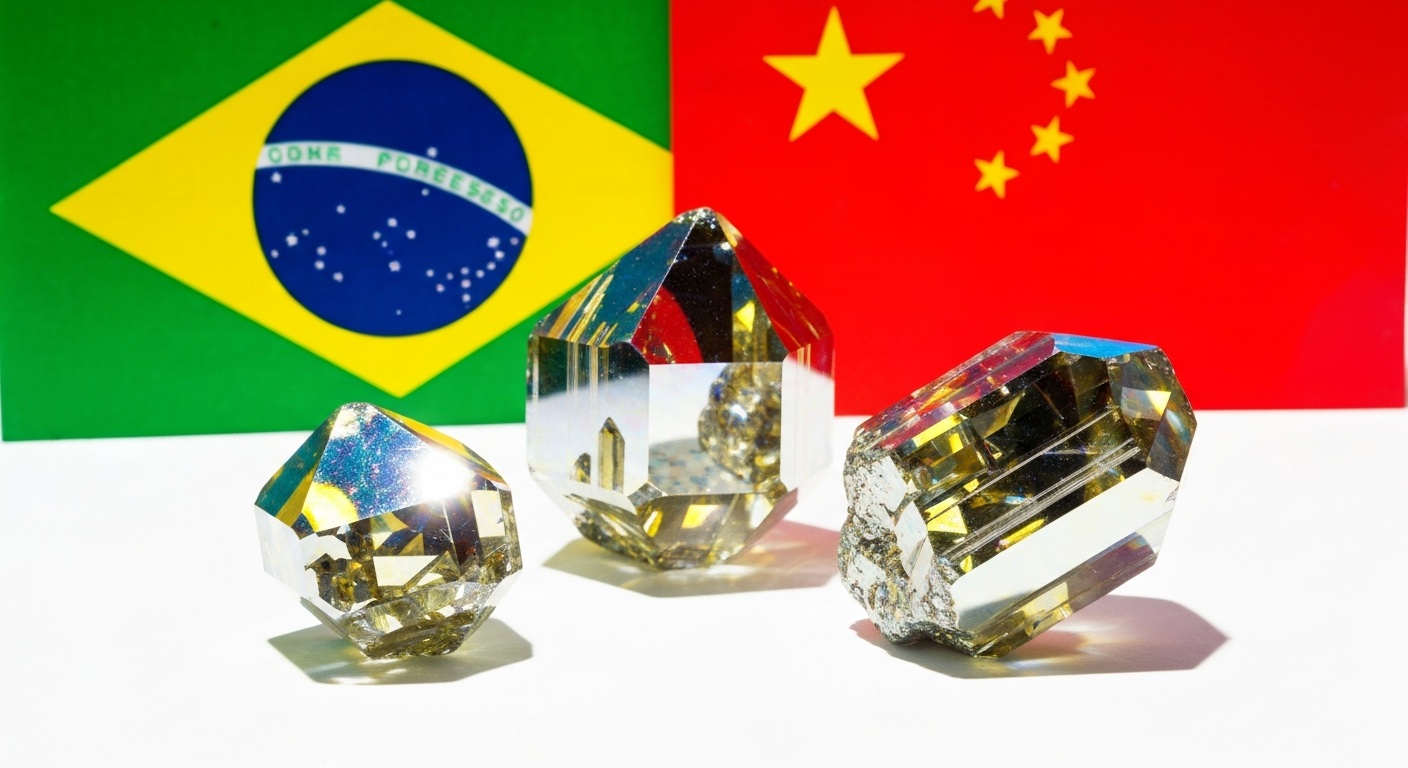
Both China and the United States know this.
What is niobium and why it matters
Niobium is a chemical element with atomic number 41, a gray-silver metal discovered in 1801 by English chemist Charles Hatchett. In the periodic table, it is next to molybdenum and above tantalum — and for a long time it was confused with the latter. The name comes from Greek mythology: Niobe, daughter of Tantalus.
In practice, niobium is added to steel in minimal proportions — usually less than 0.1% — but the effect is disproportionate. It increases the mechanical resistance of steel, allows structures to be lighter without losing strength, and improves corrosion resistance. According to data from the U.S. Geological Survey (USGS), about 90% of the world's niobium production goes into the manufacture of ferroniobium, an alloy with 60% to 70% of niobium that is incorporated into the production of special steels.
Pipelines, bridges, offshore platforms, car chassis, train rails — all of these use niobium steel. But the applications do not stop there.
Superconductors, chips, and batteries: the future of niobium
Niobium has a rare property: it becomes a superconductor at cryogenic temperatures, with the highest critical temperature among all pure elements — 9.2 K (-263.95 °C). This makes it essential for the superconducting magnets used in magnetic resonance imaging (MRI) devices, particle accelerators like CERN's LHC, and nuclear fusion equipment.
Niobium-titanium and niobium-tin alloys are the industry standard for these magnets. Without niobium, magnetic resonance as we know it would not exist.
But what is really attracting geopolitical attention are emerging applications. Researchers are testing niobium oxides in next-generation lithium-ion batteries, where the material promises faster charging cycles and greater durability. Toshiba, for example, has already developed batteries with niobium-titanium oxide (NTO) anodes that charge in a few minutes. CBMM itself has invested in research in this area, with partnerships with universities and technology companies.
In the semiconductor industry, niobium compounds are being explored as dielectrics in capacitors and in quantum computing applications. Niobium is one of the candidate materials for superconducting qubits — the basis of the quantum computers that Google, IBM, and Chinese startups are developing.
CBMM: from Araxá to the world
The story of CBMM began in 1955 when the pyrochlore deposit in Araxá was identified as the largest concentration of niobium on the planet. The deposit is hosted in a carbonatite intrusion — a rare type of igneous rock that concentrates niobium minerals in economically viable quantities.
The company was founded in 1955 and has since grown to become the absolute global market leader. According to Wikipedia (citing USGS data), in 2013 CBMM controlled 85% of global niobium production. More recent estimates place this share around 75% to 80%, considering the growth of production in other mines.
The second largest Brazilian mine is in Catalão, in the state of Goiás, and belongs to China Molybdenum (CMOC) — yes, a Chinese company. Together, the two Brazilian operations account for approximately 88% of the global niobium supply, according to USGS data.
The third largest producer is the Niobec mine, in Saint-Honoré, Quebec, Canada, owned by Magris Resources, which produces between 7% and 10% of the world's supply.
That is to say: Brazil not only leads — it practically monopolizes niobium. And CBMM is the heart of this monopoly.
The Moreira Salles family and control of CBMM
CBMM is controlled by the Moreira Salles family, one of the richest and most influential in Brazil — the same owners of Itaú Unibanco, the largest private bank in Latin America. The company does not have shares traded on the stock exchange, which means that its strategic decisions do not respond to external shareholders or to the quarterly pressure of the market.
In 2011, in a move that caught the world's attention, CBMM sold 30% of its shares to a consortium of investors. A significant portion was acquired by Asian companies, including Japanese, South Korean, and — crucially — Chinese steelmakers. This move gave Asia a seat at the table in deciding the future of niobium.
China and the appetite for niobium
China is the world's largest steel producer, responsible for more than 50% of global production. High-quality steel requires niobium. This equation explains why Beijing has a direct interest in what happens in Araxá.
But Chinese involvement goes beyond being just a buyer. China Molybdenum (CMOC), a state-owned mining company, owns the Catalão mine (GO) — the second-largest niobium operation in Brazil. The acquisition took place in 2016 when CMOC bought Anglo American's niobium and phosphate assets in Brazil for $1.5 billion. It was one of the largest Chinese investments in the Brazilian mining sector.
China also participated in the consortium that acquired a stake in CBMM in 2011. Companies such as CITIC Group, Baosteel, Anshan Iron and Steel, and other Chinese steelmakers ensured privileged access to the supply of niobium.
In terms of consumption, China is the world's largest importer of niobium. According to international trade data, Brazil exports most of its production of ferroniobium to Chinese, European, and North American steelmakers, with China leading in volume.
For Beijing, ensuring access to Brazilian niobium is not just a commercial matter — it is an industrial security issue. Without niobium, Chinese steel loses competitiveness. And China's ambitions in quantum computing and advanced batteries make the metal even more strategic.
The United States and the race for critical minerals
Washington is also paying attention. The U.S. Department of the Interior has included niobium on the list of 50 critical minerals — those considered essential for national security and vulnerable to supply disruptions. The United States does not produce domestic niobium; all demand is met by imports, mainly from Brazil and Canada.
The USGS's annual report on mineral commodities repeatedly highlights American dependence on Brazilian niobium. In a scenario of growing rivalry between the U.S. and China, this shared dependence on a single source creates a delicate geopolitical dynamic.
In 2022, the Biden administration signed the Inflation Reduction Act and the CHIPS Act, both with provisions to reduce dependence on supply chains concentrated in a few countries. Critical minerals such as lithium, cobalt, rare earths — and niobium — are at the center of these policies.
The U.S. is also trying to strengthen ties with Canada (where the Niobec mine is located) as an alternative source, but the Canadian scale does not compare to the Brazilian one. In the end, Washington needs Brazil as much as Beijing does.
Brazil in the middle of the board
Brazil occupies a privileged — and uncomfortable — position in this dispute. Having a near-monopoly on a strategic resource is a huge advantage, but it is also a target. The question that arises is: does Brazil have a strategy for niobium?
So far, the approach has been pragmatic. CBMM sells to everyone — China, U.S., Europe, Japan, Korea. There is no embargo, no explicit favoritism. Brazilian ferroniobium reaches more than 40 countries.
But voices within the government and academia are calling for a more assertive policy. Why does Brazil export niobium as raw material (ferroniobium) instead of developing the entire value chain domestically? Why not attract factories for niobium batteries, superconductors, quantum components?
The answer involves investment, technology, and political will. CBMM has done its part on the research side — the company maintains technology centers and has partnerships with universities in Brazil and abroad. But the industrialization of high value-added products from niobium is still in its infancy.
Niobium is not a meme — it is geopolitics
For years, niobium became a joke on the Brazilian internet. "If Brazil sold niobium at a fair price, it would be the richest country in the world" — the phrase circulated as a meme, usually associated with conspiracy theories. The reality is more subtle and more interesting.
Niobium is not oil. Global production is around 70,000 to 90,000 tons per year, moving a market estimated at $3 to $4 billion annually. It is a niche market, not a mass commodity. But what it lacks in volume, it makes up for in strategic importance.
A world without niobium would have heavier and less safe pipelines, less efficient aircraft engines, hospitals without magnetic resonance, and quantum computers that do not work. Few materials have this combination of critical uses and extreme geographic concentration.
And it is precisely this concentration — more than 85% of the supply in a single country, with a single company dominating — that turns niobium into a geopolitical issue. When China buys a niobium mine in Goiás, when the U.S. lists niobium as a critical mineral, when Asian investors enter CBMM's capital — all of this is geopolitics in action.
Numbers that matter
To summarize the scenario:
- ~80% of global niobium production comes from CBMM in Araxá (MG) — Source: USGS, Wikipedia
- ~88% of the global supply comes from Brazil (CBMM + Catalão mine/CMOC) — Source: USGS
- 60-70% is the niobium content in ferroniobium, the main exported product — Source: USGS
- 50+ critical minerals listed by the U.S., including niobium — Source: U.S. Department of the Interior
- $1.5 billion was the amount paid by China Molybdenum for Anglo American's niobium assets in Catalão — Source: CMOC/Anglo American
- 9.2 K is the critical temperature of niobium as a superconductor, the highest among pure elements — Source: Wikipedia/Niobium
What to watch from here on out
Niobium will gain even more relevance in the coming years. Three trends deserve attention:
1. Batteries: If the technology of batteries with niobium oxide anodes proves viable on a commercial scale, demand could skyrocket. CBMM is heavily investing in this front.
2. Quantum computing: Niobium is one of the base materials for superconducting qubits. As Google, IBM, and Chinese companies scale up their quantum computers, the demand for high-purity niobium tends to grow.
3. Critical minerals policies: Both the U.S. and the European Union are creating legislation to diversify supply chains of strategic minerals. Niobium is on these lists. This could mean more investment in recycling, substitution — or more pressure on Brazil to ensure preferential access.
Brazil has a rare trump card in international relations. The question is whether it will play this trump card strategically — or let others define the rules of the game.
This article is part of the coverage by China to Watch on how Chinese presence in Brazil connects to global dynamics of technology, minerals, and geopolitics. Follow our analyses at chinato.watch.