If you've never ridden a high-speed train in China, it's difficult to grasp what the country has accomplished with its railways over the last 18 years. We're talking about a network that exceeds 50,000 kilometers of track dedicated exclusively to high-speed trains — more than all the other countries in the world combined. This is not an exaggeration. It's a matter of math.
For reference: France, which invented the TGV and for decades was synonymous with fast trains in Europe, has about 2,800 km of high-speed lines. Japan, the birthplace of the Shinkansen, operates approximately 3,000 km. China has fifteen times more than either of them.
And what's most impressive: this network practically didn't exist in 2007.
From Zero to 50,000 Kilometers in Less Than Two Decades
The inaugural milestone was August 1, 2008, just days before the opening of the Beijing Olympics. On that day, the line between Beijing and Tianjin began commercial operations — 120 kilometers covered in about 30 minutes, at speeds reaching 350 km/h. The world took notice.
But the project had been in the works for years. In 2004, the Chinese State Council approved the "Medium and Long-Term Railway Network Plan," which called for the construction of dedicated lines connecting the country's major cities. The idea was ambitious: to create north-south and east-west high-speed corridors, forming a grid that would cover virtually all territory of any economic significance.
In the early years, China absorbed technology from abroad. It struck technology transfer agreements with Alstom (France), Siemens (Germany), Bombardier (Canada), and Kawasaki (Japan). The first trains were essentially licensed versions of foreign models, assembled locally with increasing degrees of domestication.
The turning point came quickly. In less than a decade, CRRC — the state-owned entity that unified the country's two largest railway manufacturers — was already producing trains with its own technology. Not just "inspired" by the imported models, but platforms redesigned from the ground up with Chinese engineering.
The Fuxing: National Pride on Rails
The symbol of this technological independence is the CR400AF Fuxing, which entered commercial service in 2017. "Fuxing" means "rejuvenation" in Mandarin — a direct reference to Xi Jinping's political project of restoring China to what the party considers its historical position among the great powers.
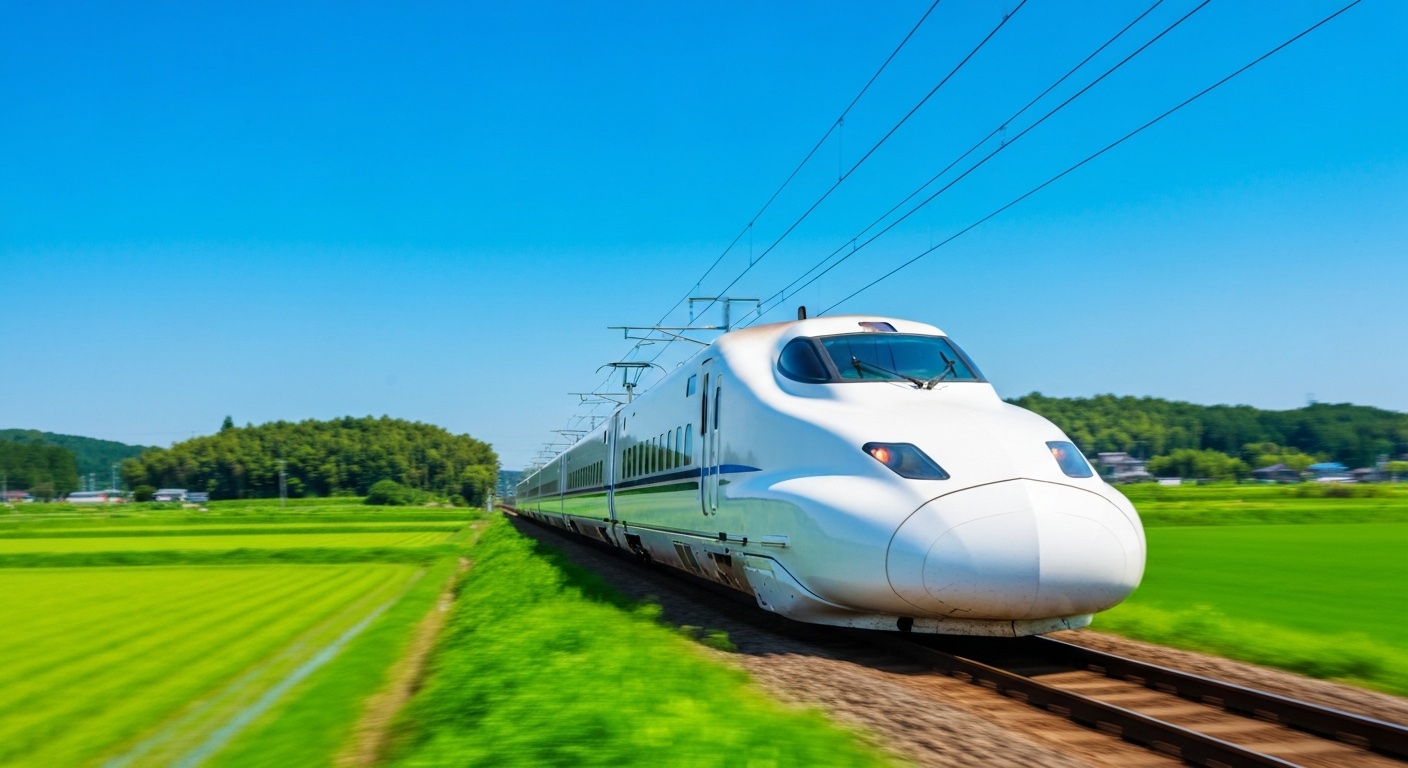
Setting politics aside, the train is an impressive machine. It operates at 350 km/h on regular service on the Beijing-Shanghai line (1,318 km in about 4 hours and 18 minutes). It was designed to reach 400 km/h, and in tests, it achieved 420 km/h. The cabin is quiet — noticeably so compared to a cruising airplane — the second-class seats are more spacious than the economy class of any airline, and there are USB and 220V outlets at every row.
The Fuxing was also the world's first high-speed train with real-time fault detection and autonomous emergency braking capability. It has more than 2,500 sensors monitoring each trainset, covering everything from axle temperature to the structural integrity of the tracks ahead.
Today there are various variants: the CR400BF (from the other CRRC division), 8-car and 16-car versions, models adapted for extreme cold in the northeast (-40°C) and versions for high altitudes on the Tibetan plateau. Cumulative production has already surpassed 1,000 trainsets.
The 600 km/h Maglev: The Next Chapter
As if 350 km/h weren't enough, China has also developed a prototype magnetic levitation (maglev) train capable of reaching 600 km/h. The vehicle was unveiled in Qingdao in July 2021, manufactured by CRRC Sifang.
Unlike a conventional high-speed train, which runs on steel rails, the maglev floats on a magnetic field — eliminating mechanical friction and allowing for much higher speeds. The technology isn't new (Shanghai's German-origin Transrapid has been operating since 2004 at 430 km/h), but the Chinese project is entirely domestic and was designed for longer distances.
The practical application still has no set date. Building a long-distance maglev line requires completely different infrastructure and significantly higher costs than a conventional high-speed train. But the prototype exists, it works, and the engineering is validated. When — and not if — it makes economic sense, China will be ready to implement it.
The most discussed corridor is Beijing-Shanghai: the 1,318 km that currently take 4h18 by Fuxing would be covered in a little over 2 hours. It would be competitive with door-to-door air travel, considering travel to the airport, check-in, and waiting times.
How Much Does It Cost to Ride a High-Speed Train in China
One of the things that most surprises visitors to China is the price of tickets. Second class (equivalent to economy) on the Beijing-Shanghai route costs about 553 yuan — approximately R$ 400 at the current exchange rate. That's 1,318 km in 4 hours and 18 minutes.
For comparison: a flight on the same route costs between 600 and 1,200 yuan depending on how far in advance you book, but when you add the travel to the airport, checking in 45 minutes beforehand, and the trip from the destination airport to the city center, the train almost always wins on total time — and always wins on comfort.
First class costs about 933 yuan (~R$ 670) and business class, available on some 16-car trainsets, is around 1,748 yuan (~R$ 1,260). In the latter, the seat reclines completely into a bed, and the service includes a meal.
Shorter routes are proportionally cheaper. Shanghai-Hangzhou (175 km, 45 minutes) costs 73 yuan in second class — less than R$ 55. Guangzhou-Shenzhen (105 km, 30 minutes) costs 74.5 yuan. It's the kind of price that turns neighboring cities into neighborhoods of a single functional metropolis.
Are these values subsidized? Partially. China Railway, the state-owned operator, has accumulated debts exceeding 6 trillion yuan (more than US$ 800 billion). The government absorbs this cost as an investment in infrastructure and economic integration, not as a business that needs to be profitable on its own. The Beijing-Shanghai line is one of the few that operates in the black.
And Brazil? The Story of the TAV That Never Left the Drawing Board
In 2007 — a year before China inaugurated its first line — the Brazilian government announced the project for the High-Speed Train (TAV) linking São Paulo to Rio de Janeiro, with a stop in Campinas. It would be 510 kilometers, a maximum speed of 300 km/h, and an estimated travel time of 1 hour and 33 minutes.
The project was announced as one of the major works for the 2014 World Cup and the 2016 Olympics. The initial estimated cost was R$ 33 billion. In 2010, ANTT held the first concession auction. No consortium appeared. The tender was reissued. Again, no proposals. The government tried a third time, relaxing the terms. Same result.
The reasons were varied: underestimated cost (independent estimates spoke of R$ 50 to 80 billion), the complexity of the terrain between São Paulo and Rio (Serra do Mar), insufficient intermediate demand, currency risk for imported equipment, and — perhaps most decisively — a lack of real political will to fund the project beyond the announcements.
In 2014, the TAV was officially shelved. The land that had been partially expropriated was returned. The feasibility studies became reports gathering dust in BNDES files. Brazil remains without a single kilometer of high-speed railway.
The contrast with China is stark, but it deserves context. China had (and has) a central government with the capacity to mobilize resources, expropriate land, and execute works on a scale that no Western democracy can replicate at the same speed. The social and environmental cost of these projects is often subordinated to the goal — something that, like it or not, accelerates execution.
But Brazil's failure isn't explained solely by the difference in political systems. India, also a noisy and bureaucratic democracy, is building its first high-speed line (Mumbai-Ahmedabad, 508 km) with Japanese technology. Indonesia inaugurated the Jakarta-Bandung line in 2023 with Chinese technology. Morocco has operated Africa's first high-speed train since 2018.
Brazil's problem with major infrastructure projects is more profound: short political cycles that discourage long-term projects, the judicialization of expropriations, an inability to maintain multi-year budgets, and an institutional culture that treats planning as a disposable theoretical exercise with every change of government.
What the Chinese Network Means for the Rest of the World
China didn't build 50,000 kilometers of track just to solve a domestic transportation problem. The high-speed network is also a technological showcase. Through CRRC and engineering firms like China Railway Construction Corporation, the country exports complete packages: trains, tracks, signaling, design, and financing.
Indonesia was the first Southeast Asian country to buy the complete package. The Jakarta-Bandung line (142 km) cost about US$ 7.3 billion and uses trains based on the Fuxing platform. Laos inaugurated in 2021 a 414 km railway linking Vientiane to the Chinese border — part of a strategy to connect Southeast Asia to the Chinese railway network.
Thailand, Malaysia, and even Saudi Arabia are at various stages of negotiation or construction with Chinese suppliers. The high-speed railway has become one of the most concrete instruments of the Belt and Road Initiative.
The Experience of Riding a High-Speed Train in China
Numbers and geopolitics aside, riding a high-speed train in China is an experience that is worthwhile in itself. The stations are enormous — many make international airports look modest. Boarding is done with an identity document or passport scanned electronically. On popular routes, trains run every 5-10 minutes.
Inside the train, the silence is surprising. The second-class seat has plenty of legroom. The Wi-Fi works (with the usual limitations of the Chinese internet). The dining car serves hot meals for 40-60 yuan. And out the window, the landscape changes from metropolis to rice paddy and back to metropolis at a speed that makes you rethink distances.
It's the kind of infrastructure that, once you experience it, it's hard to accept the alternative. Anyone who takes the Fuxing from Beijing to Shanghai is unlikely to consider domestic flying as their first option again.
To Learn More
If you're interested in China — technology, culture, business, daily life — chinato.watch covers it all in English, without filters and without beating around the bush. Follow it to understand what's happening in the country that is redefining infrastructure, artificial intelligence, and global trade.