China Leads the Autonomous Vehicle Race — and the West is Falling Behind
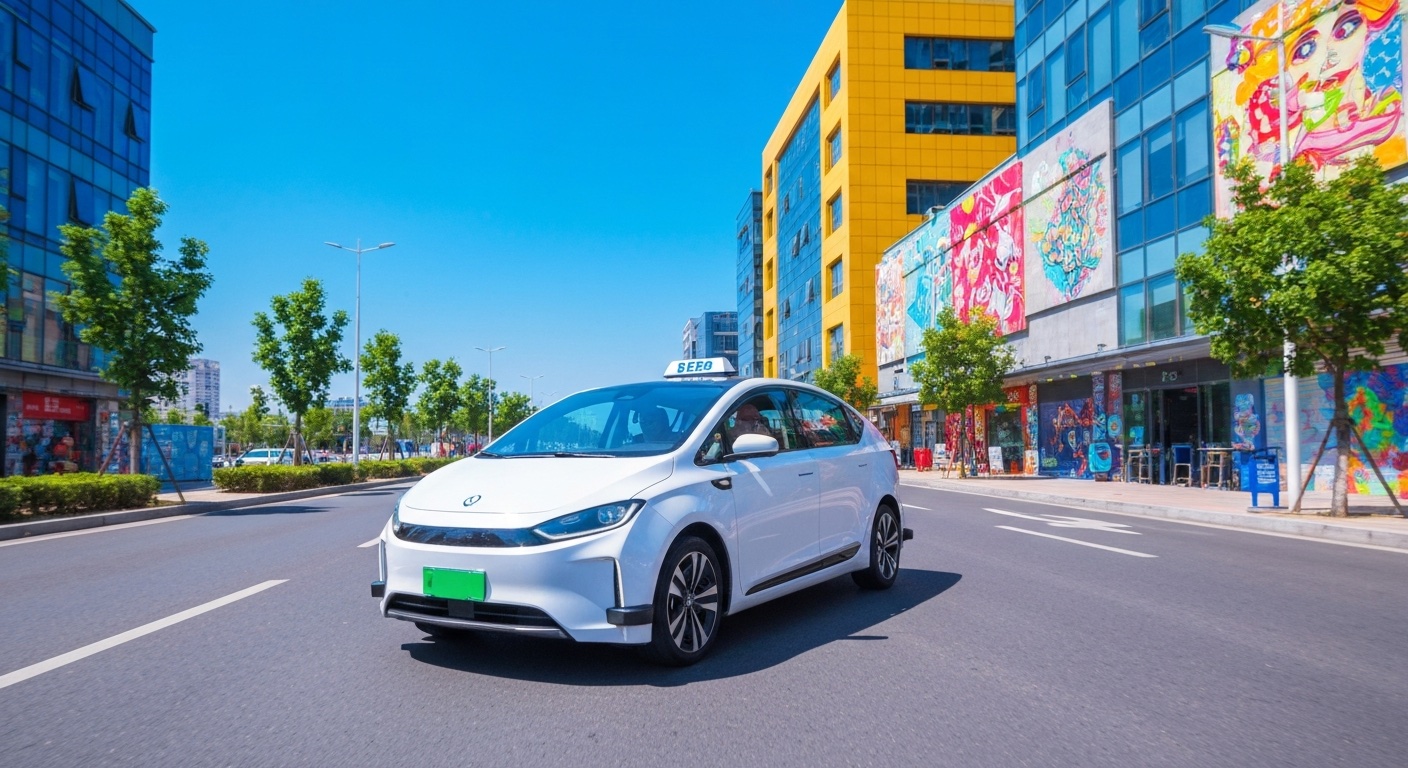
While in the United States and Europe autonomous driving advances amidst regulatory debates and limited tests, China has turned its largest cities into live laboratories for robo-taxis. In Wuhan, Beijing, Shenzhen, and Chongqing, driverless vehicles are already transporting passengers on paid commercial routes. It's not a promise of the future. It's the present.
The protagonist of this revolution is Apollo Go, the robo-taxi service of Baidu — but WeRide and Pony.ai are also in the race. And Li Auto, one of the country's largest electric vehicle manufacturers, promises to deliver level 4 (SAE) autonomous driving in their passenger cars by 2028. For those who follow the Chinese market, the message is clear: autonomous vehicles in China in 2028 will not be the exception, they will be routine.
Baidu Apollo Go: The World's Largest Robo-Taxi Service
Apollo Go (萝卜快跑, or "Luobo Kuaipao") was born in September 2020 when Baidu launched its autonomous taxi service on the streets of Beijing. Since then, the operation has grown at a speed that leaves global competitors — including Google's Waymo — on the defensive.
By July 2024, Apollo Go covered 11 Chinese cities with passenger transportation services. In four of those cities — Beijing, Wuhan, Chongqing, and Shenzhen — the vehicles already operate in fully autonomous mode, without a safety driver on board. Wuhan has become the epicenter of the operation, with plans to receive 1,000 sixth-generation vehicles (the Apollo RT6) in commercial operation.
The Apollo RT6, presented at Baidu World 2022, was specifically designed as an autonomous vehicle — it's not an adapted car. Built on the "Apollo Galaxy" platform, it has total redundancy in steering, computing, and braking systems. The cost per unit is around 250,000 yuans (approximately BRL 180,000), a fraction of what Waymo's autonomous vehicles cost.
In July 2022, Beijing approved the country's first commercial program for driverless trips, authorizing an initial fleet of 25 BAIC Arcfox vehicles for regular paid service. Weeks later, Wuhan and Chongqing issued the first national licenses for fully autonomous commercial operation on public roads.
The expansion did not stop in mainland China. In November 2024, the Hong Kong Transport Department granted Apollo Go the first pilot license for autonomous vehicles in the territory. And in August 2025, Baidu signed an agreement with Lyft to bring its robo-taxis to Europe — with vehicles manufactured by Jiangling Motors expected to operate in Germany and the United Kingdom from 2026.
How Much Does a Robo-Taxi Ride Cost in China?
One of the factors driving the mass adoption of Apollo Go is the price. In Wuhan, a robo-taxi ride costs between 4 and 16 yuans (BRL 3 to BRL 12), depending on the distance — values that compete directly with public transport and are significantly cheaper than traditional taxis or ride-hailing services like Didi.
This aggressive price is possible because the cost of the Apollo RT6 (250,000 yuans) is a fraction of what the competition spends. For comparison, the Jaguar I-PACE vehicles used by Waymo in the US cost over USD 100,000 each, not including additional sensors. The scale of industrial production in China and the vertical integration of the supply chain make a real difference in the final bill.
WeRide: From the Lab to Nasdaq
Founded in 2017 in Silicon Valley by Tony Han — former chief scientist of Baidu's autonomous driving division — WeRide has become one of the most ambitious companies in the sector. Listed on Nasdaq (WRD) and the Hong Kong Stock Exchange (800), the company employs over 2,000 employees and operates offices in China, the USA, the United Arab Emirates, and Singapore.
In its first year of robo-taxi service (up to November 2020), WeRide completed 147,128 trips for over 60,000 passengers. Since then, the operation has diversified: in addition to robo-taxis, the company operates the Mini Robobus (an autonomous minibus seen on the streets of Guangzhou), the Robovan (an autonomous cargo van), and the Robosweeper S1 (an autonomous urban cleaning vehicle).
WeRide holds driverless driving licenses in five countries: China, the United States, the United Arab Emirates, Singapore, and France. In 2023, the company obtained the first national license from the United Arab Emirates for autonomous vehicles on public roads. In June 2024, it signed a partnership with Uber to offer robo-taxis via app in Abu Dhabi — the first service of its kind in the Middle East.
The partnership with Renault, announced in May 2024, signals that WeRide is aiming at the European market as the next step in global expansion.
Pony.ai: The Startup That Fell, Got Up, and Went Public
Pony.ai's trajectory illustrates both the potential and the challenges of autonomous driving. Founded in December 2016 by James Peng and Tiancheng Lou (both ex-Baidu), the company established itself simultaneously in Silicon Valley and Guangzhou.
In the US, Pony.ai accumulated the third-largest number of miles driven in autonomous testing in California in 2021, behind only Waymo and Cruise. But it also faced serious problems: in October 2021, an autonomous vehicle from the company collided with a lane divider in Fremont, leading to the revocation of its driverless testing license by the California DMV — the first revocation of its kind in the agency's history. In May 2022, the license was revoked for failures in safety driver monitoring.
The company recovered. In June 2023, it resumed testing in California (with safety drivers) and, in China, obtained licenses for fully commercial autonomous services in Beijing and Guangzhou. Pony.ai went public on Nasdaq (PONY) and the Hong Kong Stock Exchange (2026), has a strategic partnership with Toyota, and employs about 1,300 employees.
Li Auto and the Promise of Level 4 by 2028
If Baidu, WeRide, and Pony.ai focus on commercial fleets (robo-taxis, buses, logistics), Li Auto bets on bringing advanced autonomous driving directly to the end consumer. The Beijing-based manufacturer, founded by Li Xiang in 2015, produced 406,343 vehicles in 2025 and recorded revenue of 144.46 billion yuans in 2024 (about BRL 104 billion).
The company already equips its SUVs with advanced driver assistance systems (ADAS) and heavily invests in research and development — there are 32,248 employees, most of them in software engineering. Li Auto's declared plan is to achieve SAE level 4 autonomous driving — where the vehicle drives alone in defined scenarios without any human intervention — by 2028.
This goal is not as far away as it seems. Li Auto already implements assisted driving features on highways and in mapped urban scenarios. The leap to level 4 requires solving the problem of "edge cases" — unexpected situations that deviate from the norm — and ensuring total redundancy in sensors and decision-making software. With the volume of data generated by hundreds of thousands of vehicles on Chinese roads, the company accumulates a competitive advantage that few Western manufacturers possess.
If Li Auto meets its goal, its buyers will have, by 2028, a car that drives alone in many urban and highway situations. For the Brazilian market, where the brand already generates curiosity, this could represent a paradigm shift in what is expected from an imported vehicle from China.
Chinese Regulation vs. American Approach: Opposite Philosophies
One of the central factors that explain China's lead is the regulatory approach. While the US adopts a fragmented model — each state has its rules, and incidents like those involving Cruise in San Francisco have led to license suspensions — China bets on a gradual controlled expansion model.
The Chinese government allows cities to function as "demonstration zones" with progressive rules. Wuhan, for example, started with limited tests, moved on to operation with a safety driver, then to driverless operation in restricted areas, and finally to full commercial service. Beijing, Shenzhen, and Chongqing followed similar paths.
This approach has clear advantages: companies accumulate real operational data on a massive scale, the public gradually gets used to the technology, and the government maintains control over the speed of expansion. There is no political battle like in the US, where technology companies oppose drivers' unions and municipal governments.
In California, the DMV can revoke licenses after a single incident. In China, the regulatory focus is on demonstrating safety at scale — if the fleet as a whole maintains acceptable indicators, the operation continues and expands. This philosophical difference explains why Apollo Go already operates commercially in 11 cities while Waymo still focuses on Phoenix, San Francisco, and Los Angeles.
What Does This Mean for Mobility in Brazil?
Brazil is far from having robo-taxis on the streets. Brazilian legislation does not even have a specific regulatory framework for autonomous vehicles, and issues such as civil liability in case of accidents still lack a clear legal answer. But the Chinese advances impact Brazil in less obvious — and more important — ways than it seems.
First: advanced ADAS vehicles are already arriving in Brazil. Chinese brands like BYD, GWM, and Chery sell cars in the country with driver assistance systems that, although not autonomous, incorporate technologies developed in the Chinese autonomous driving ecosystem — cameras, radars, LiDAR, sensor fusion software. Li Auto, if it decides to export to Brazil, will bring this package at an even more advanced level.
Second: the cost of technology is falling. When Baidu produces the Apollo RT6 for 250,000 yuans and WeRide scales its global operation, components — LiDAR sensors, neural processing chips, high-resolution cameras — become cheaper for the entire industry. This means that even popular cars will start to incorporate features that are currently exclusive to premium models.
Third: regulatory pressure increases. As other countries — United Arab Emirates, Singapore, Germany, United Kingdom — define legal benchmarks for autonomous vehicles, Brazil will need to position itself. Chinese companies that already operate under complex regulations in multiple countries will have a competitive advantage when entering new markets, including the Brazilian market.
Fourth: the urban transportation model changes. Robo-taxis with dramatically lower operating costs than traditional taxis could transform public transport in cities struggling with precarious systems. If this technology arrives in Brazil — and the Baidu-Lyft partnership for Europe shows that internationalization is a matter of time — cities like São Paulo, Curitiba, and Belo Horizonte could benefit from complementary autonomous fleets to mass transit.
The Numbers That Define the Race
To gauge the scenario, it is worth consolidating the main data:
- Apollo Go (Baidu): 11 cities with active service; fully autonomous operation in Beijing, Wuhan, Chongqing, and Shenzhen; Apollo RT6 at 250,000 yuans per unit; license in Hong Kong (2024); agreement with Lyft for Europe (2025); expansion to Germany and the United Kingdom expected for 2026.
- WeRide: IPO on Nasdaq and Hong Kong; 2,000+ employees; 147,128 trips in the first year; licenses in 5 countries; partnership with Uber (Abu Dhabi) and Renault.
- Pony.ai: IPO on Nasdaq and Hong Kong; 1,300 employees; partnership with Toyota; commercial license in Beijing and Guangzhou; third-largest volume of testing in California (2021).
- Li Auto: 406,343 vehicles produced (2025); revenue of 144.46 billion yuans (2024); 32,248 employees; goal of level 4 SAE by 2028.
The Future is Autonomous — and Speaks Mandarin
Autonomous driving has left the realm of science fiction to become urban infrastructure in China. The pace of expansion of Apollo Go, combined with the global ambition of WeRide and Pony.ai and Li Auto's plans for the end consumer, creates an ecosystem that no other country currently replicates.
For Brazil, the question is not whether this technology will arrive, but when and on what terms. Those who follow the advance of Chinese technology — and understand that brands like Baidu, WeRide, and Li Auto are not distant names, but players knocking on the door of the global market — will be better prepared for the transformations that lie ahead.
Want to closely follow how Chinese technology is transforming global mobility? Subscribe to the China to Watch newsletter and receive weekly analyses directly in your email. No hype, no empty promises — just data and context for those who want to understand the China that matters.
Publication sources
- Apollo Go - Wikipedia ↗
- WeRide - Wikipedia ↗
- Pony.ai - Wikipedia ↗
- Li Auto - Wikipedia ↗
- Apolong (Baidu Apollo) - Wikipedia ↗
- Baidu World 2022 - Apollo RT6 announcement ↗
- Lyft and Baidu in Deal to Use Chinese Driverless Cars in Europe - The New York Times ↗
- Comparing Robotaxis: Baidu's Apollo and Alphabet's Waymo - Stanford CIS ↗
- China's robotaxis are racing ahead of Tesla's - The Economist ↗