
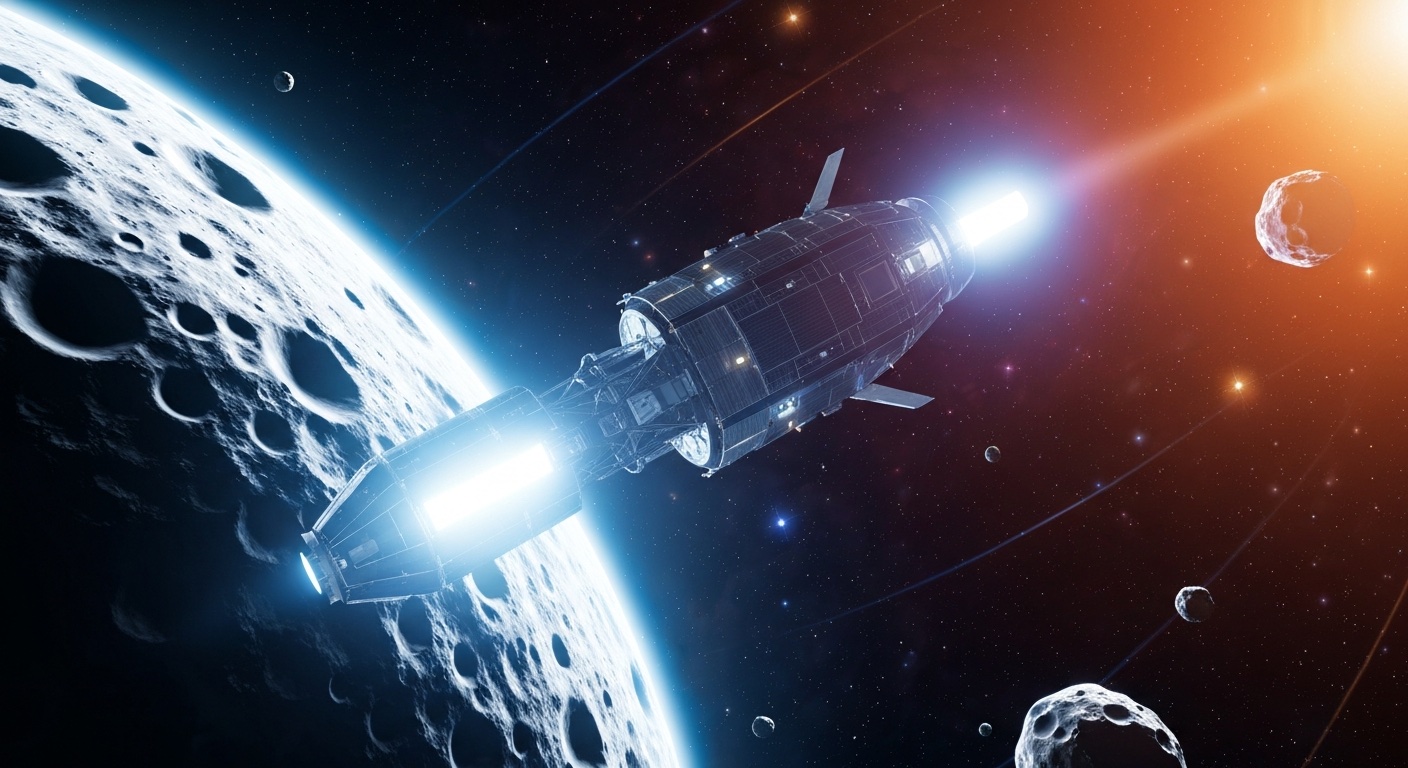
The science fiction becomes a business plan
For decades, the idea of extracting minerals from asteroids belonged to the realm of science fiction novels. Books like Scavengers in Space and Miners in the Sky, published in the 1960s, imagined fleets of miners crossing the asteroid belt in search of cosmic wealth. Nobody took it seriously — until the numbers started to make sense.
In May 2025, China launched the Tianwen-2 probe aboard a Long March 3B rocket, departing from the Xichang Satellite Launch Center. The mission will not mine anything — yet. But it will collect samples from a near-Earth asteroid and bring them back. It is the most concrete step taken so far in the direction of turning asteroid mining into an industrial reality.
What once seemed like a fantasy now attracts billions in investments. The space economy is expected to reach US$ 1 trillion by 2040, according to industry estimates. And asteroid mining, with its deposits of platinum, rare earths, and strategic metals, could be the missing piece to sustain this expansion.
Tianwen-2: the mission that aims at the asteroid Kamoʻoalewa
The Tianwen-2 is the second interplanetary mission of the China National Space Administration (CNSA). Launched on May 28, 2025, it has a dual objective: first, to visit the asteroid 469219 Kamoʻoalewa (also designated 2016 HO3); then, to head towards the comet 311P/PanSTARRS. The total duration is expected to be 10 years.
The Kamoʻoalewa is a fascinating celestial body. Discovered in 2016 by the Pan-STARRS telescope in Hawaii, it measures between 40 and 100 meters in diameter and spins on its own axis every 28 minutes. Technically, it is an almost-satellite of Earth — orbiting the Sun on a path almost identical to ours, at a distance that varies between 0.90 and 1.10 astronomical units.
Researchers suspect that Kamoʻoalewa is, in fact, a lunar fragment — a piece of the Moon torn off by an ancient impact. Its spectral composition resembles materials from the lunar surface exposed to space weathering, particularly soils collected by the Apollo 14 and Luna 24 missions. Some scientists suggest that it originated from the Giordano Bruno crater, on the far side of the Moon.
The probe is expected to reach the asteroid's orbit on June 7, 2026, initiating the encounter and sample collection in July of the same year. The plan is to collect at least 100 grams of regolith — the loose material from the surface. To do this, Tianwen-2 will use two methods: the traditional "touch-and-go" used by the Hayabusa2 and OSIRIS-REx missions, and an unprecedented method of direct anchoring on the asteroid. It will be the first time this technique is tested on a celestial body. Explosives will also be used to expose volatile subsurface materials.
After exploring Kamoʻoalewa between July 2026 and April 2027, the probe will return to Earth in November 2027, releasing a capsule with the samples. The main module will then use a gravitational assist maneuver to continue its journey towards the 311P/PanSTARRS comet, with an expected arrival in January 2035.
What's inside an asteroid — and how much it's worth
When Earth formed over 4 billion years ago, heavy elements such as platinum, gold, cobalt, and nickel were sucked into the planet's molten core by gravity. The Earth's crust remained relatively poor in these metals. The deposits we mine today largely exist thanks to a rain of asteroids that replenished the crust with these elements billions of years ago.
Asteroids have preserved this original composition intact. And the numbers are impressive:
- Type M asteroids (metallic) contain significant concentrations of platinum group metals (PGMs): platinum, palladium, rhodium, iridium, osmium, and ruthenium. Iridium, for example, is traded at thousands of dollars per ounce.
- Type S asteroids (silicate) carry nickel, iron, cobalt, and other metals. Kamoʻoalewa is probably of this type.
- Type C asteroids (carbonaceous) are rich in water, carbon, and phosphorus — raw materials for fuel and fertilizers in space.
AstroForge, an American space mining startup, estimates that the asteroid mining industry will be a trillion-dollar market. The reasoning is straightforward: global demand for platinum group metals already exceeds terrestrial supply, conventional mining margins are around 7%, and there are about 300,000 metal-rich asteroids within reach of current technology.
But bringing material back is expensive. The three sample return missions completed to date — Hayabusa (JAXA), Hayabusa2 (JAXA), and OSIRIS-REx (NASA) — cost a total of approximately US$ 1.61 billion and brought about 127 grams of asteroidal material to Earth. Tianwen-2, with an estimated budget of US$ 70 million, promises to be significantly cheaper and bring at least 100 grams.
China vs. United States: the race for space mining
The race for asteroid mining has two clear poles: the Chinese state program and the American private ecosystem.
On the Chinese side, the approach is systematic and state-run. The CNSA published a deep space exploration roadmap covering the period 2020-2030 in 2018, developed by the Chinese Academy of Sciences. The plan includes not only Tianwen-2 but also Tianwen-3 — a Mars sample return mission scheduled for launch at the end of 2028. China is also considering sending a fleet of cubesats to fly over the asteroid Apophis when it passes close to Earth in 2029.
The cost of Tianwen-2, estimated at US$ 70 million, is a fraction of what the Americans have spent on similar missions: US$ 150 million on the Japanese Hayabusa2, US$ 1.16 billion on OSIRIS-REx. If China can return quality samples for this amount, it will have demonstrated a brutal competitive advantage in cost-benefit.
On the American side, the model is led by private initiative — with mixed results. Planetary Resources, founded in 2012 by billionaires like Eric Anderson and Peter Diamandis, with advisors like James Cameron and investors like Larry Page and Eric Schmidt, promised space fuel depots by 2020. It went bankrupt in 2018 and was sold to ConsenSys, a blockchain company. Deep Space Industries, founded in 2013, also pivoted from mining to selling thrusters and was acquired by Bradford Space in 2019.
The new generation is represented by AstroForge, founded in 2022 in Huntington Beach, California. The company raised about US$ 13 million in seed capital and focuses exclusively on the extraction and sale of platinum group metals from type M asteroids. However, its first two missions failed: Brokkr-1, launched in April 2023, had communication problems; Odin, launched in February 2025 as a rideshare on the IM-2 lunar mission, also failed due to problems with ground stations. The third mission, DeepSpace-2, is scheduled for 2026 and aims to be the first private landing on a body outside the planet's gravitational well.
Another relevant company is TransAstra, which works on asteroid capture and processing technologies using solar concentrators. The concept is to heat the asteroid's surface with concentrated sunlight to extract water and volatiles — potentially cheaper than mechanical drilling techniques.
The obstacles that no one ignores
It would be dishonest to paint asteroid mining as something inevitable without mentioning the real obstacles:
Transport cost: Taking material from low Earth orbit (LEO) to a nearby asteroid requires a velocity change (Δv) of about 5.5 km/s — less than going to the lunar surface (6.3 km/s), but still a monumental energy challenge for heavy loads.
Target identification: Knowing which asteroids really contain valuable metals requires prior prospecting. The culture of corporate secrecy makes data sharing difficult. Companies like AstroForge keep secret which asteroids are in their sights — a change from the transparency of government missions.
Space processing: Bringing raw ore back to Earth is prohibitive on a large scale. The most viable scenario involves refining the material in space itself, using in-situ resource utilization (ISRU) techniques. But this technology is still in the experimental stage.
Regulatory framework: Who owns an asteroid? The US Congress held a hearing on space mining in December 2023, recognizing the growing interest. But the international legal framework is still vague.
Why China has the advantage — for now
The big difference between the Chinese and American approaches is the time horizon. Private companies need to show returns to investors in short cycles. State programs can plan in decades.
The CNSA does not need to mine an asteroid tomorrow to justify Tianwen-2. Every gram of regolith brought back in 2027 will feed research on mineral composition, extraction techniques, and economic viability that will inform future missions. It is an investment in knowledge — the kind of bet that governments do better than startups.
The drastic reduction in launch costs, driven by SpaceX with its reusable rockets, benefits all competitors. But China has its own reusable rocket program in development and an increasingly autonomous space supply chain.
Moreover, China currently controls about 60% of the global processing of rare earths — critical elements for batteries, wind turbines, and electronics. If asteroid mining becomes viable, Beijing will have both the processing expertise and the launch capacity to dominate this market.
From 2025 to 2035: the calendar that matters
The next 10 years will determine whether asteroid mining remains a promise or becomes an industry. Here are the main milestones:
- June 2026: Tianwen-2 arrives at the asteroid Kamoʻoalewa and begins collection operations.
- November 2027: Capsule with asteroid samples returns to Earth.
- 2026: AstroForge plans DeepSpace-2 mission, the first private landing on an asteroid.
- End of 2028: China launches Tianwen-3 for Mars sample return.
- 2029: Asteroid Apophis passes 31,000 km from Earth — China studies sending cubesats for flyover.
- January 2035: Tianwen-2 arrives at comet 311P/PanSTARRS for exploration.
If Tianwen-2 brings back samples with relevant mineral composition, expect a leap in investments — public and private — in space mining. If it fails, the calendar moves back a decade.
Space as an extension of terrestrial geopolitics
Asteroid mining is not just a technological issue. It is geopolitics. Whoever controls access to strategic metals off Earth will have an unprecedented power lever.
Today, entire production chains — from electric cars to semiconductors — depend on metals whose terrestrial supply is finite and geographically concentrated. Platinum mainly comes from South Africa and Russia. Rare earths are processed almost exclusively in China. Cobalt depends on the Democratic Republic of the Congo.
A 500-meter diameter metallic asteroid can contain more platinum than all of human history's production. This is not speculation — it is the conclusion of researchers who study the composition of metallic meteorites, which are fragments of type M asteroids.
China understands this. Tianwen-2 is not just science. It is the first move in a much larger game.
Follow the Chinese space race
Asteroid mining is just one of the fronts where China is rewriting the rules of the game. From the Tiangong space station to the Chang'e lunar program, Beijing advances with method and scale. China to Watch covers every step of this transformation with depth and without frills.
If this article brought new perspectives, share it with those who need to understand what China is doing in space — before the headlines reach the facts.
