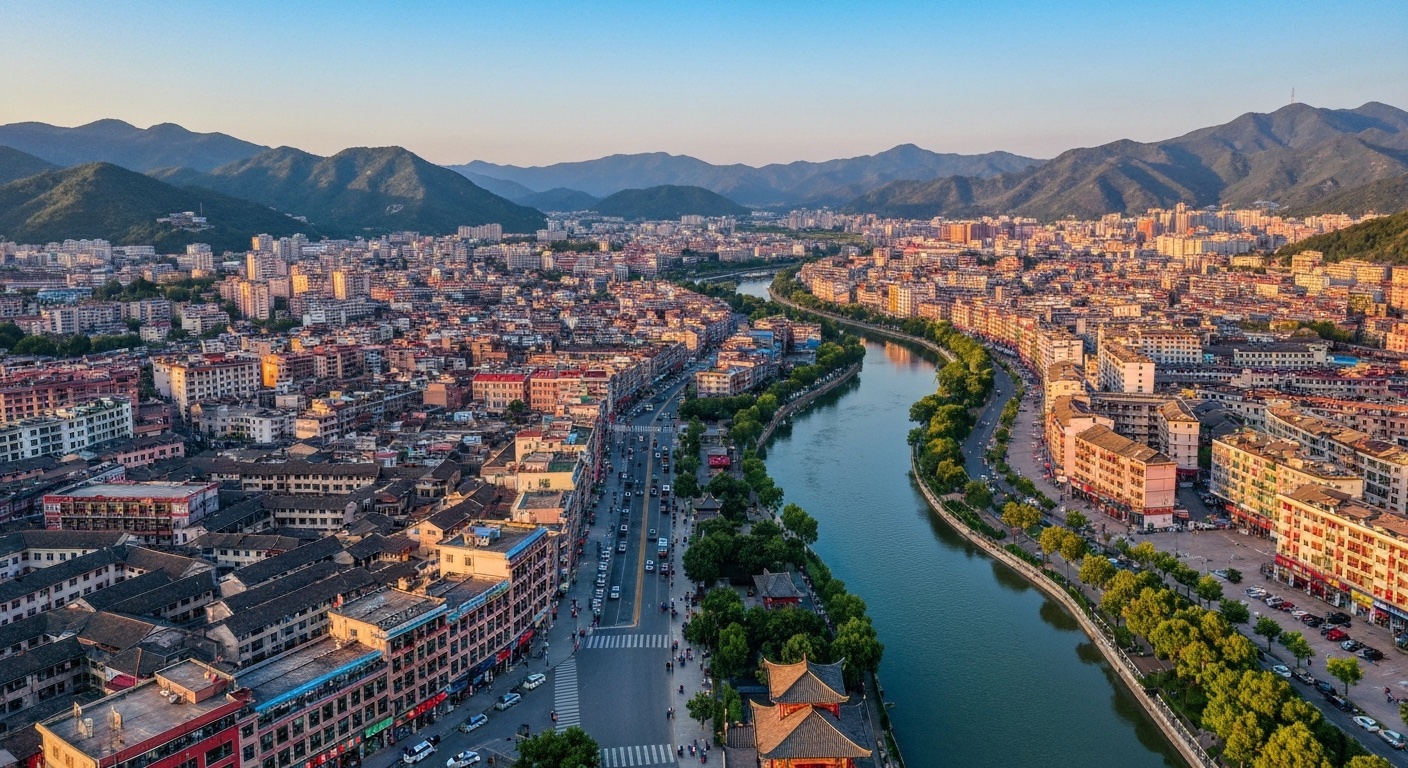
10 Chinese cities that should be on your radar (and you've never heard of)
Beyond Beijing and Shanghai: Chinese cities with more than 10 million inhabitants, GDP larger than entire countries, and surprising innovation.
Phelipe Xavier
Creator of China to Watch · lives in China · February 20, 2026 · 8 min read
Suzhou is China's richest city without its own airport
Suzhou, in Jiangsu province, recorded a GDP of approximately 2.67 trillion yuan in 2024, according to data from the National Bureau of Statistics Guójiā Tǒngjì Jú. This places the city's economy above the GDP of countries such as Portugal or the Czech Republic. The population is around 12.9 million inhabitants. Here lives the Suzhou Industrial Park, a technology park inaugurated in partnership with Singapore that houses giants like Samsung and BOE Technology.
The surprising fact is that Suzhou, despite being one of the country's most prosperous cities, does not have its own airport. Residents use Shanghai Pudong or Shanghai Hongqiao airports, which are about 30 minutes away by high-speed train. This demonstrates the level of integration of the Yangtze River Delta region. The city is famous for its classical Chinese gardens, a UNESCO heritage site, but today it is a hub of high-tech manufacturing and biotechnology. For Brazilians, Suzhou is like Guarulhos in São Paulo, but independent and much richer.
Chengdu has more inhabitants than Chile and is the capital of China's game industry
Chengdu, the capital of Sichuan province, has led the ranking of first-tier cities for several consecutive years, according to research by Yicai. The city houses approximately 21 million people in its administrative area, a number higher than the total population of Chile. Chengdu's GDP exceeded 2.2 trillion yuan in 2024, consolidating its position as the economic center of western China.
Here is the headquarters of game developer Tencent Chengdu and dozens of independent studios, making the city the largest production hub of electronic games in Asia. Chengdu also houses the giant panda breeding base. The cost of living is lower than in Shanghai, which attracts young technology professionals from all over the country. The recently inaugurated Tianfu International Airport is one of the largest in the world. Chengdu proves that China's interior does not mean backwardness; it is a São Paulo on a larger scale, but with more greenery and spicy food.
Hangzhou is where Alibaba turned a lake into Silicon Valley
Hangzhou, the capital of Zhejiang, is the birthplace of Alibaba, founded by Jack Ma in this city in 1999. The local GDP exceeds 2 trillion yuan, and the population is about 12.5 million. The city hosted the 2022 Asian Games, held in 2023, with technological infrastructure that included autonomous vehicles and 100% digital payments, according to Xinhua reports.
The West Lake, a cultural heritage site, coexists with the Future Science and Technology City, where companies like NetEase and Dahua Technology operate. Hangzhou is considered the capital of China's digital economy. The city has the highest number of unicorns per capita in the country, second only to Beijing and Shanghai. For Brazilians working with e-commerce, Hangzhou is equivalent to a mix of Campos do Jordão with Silicon Valley, but moving more money than the São Paulo Stock Exchange on peak days.
Chongqing is a city of 32 million people built vertically
Chongqing is one of China's four direct municipalities, alongside Beijing, Shanghai, and Tianjin. Its administrative population is approximately 32 million inhabitants, a number higher than the entire population of Australia. The city's GDP rivals that of Guangzhou, exceeding 3 trillion yuan in recent projections, according to Yicai data.
Known as the mountain city, Chongqing was built on rugged terrain along the Yangtze River. Here is the assembly of Changan Automobile vehicles and the production of BOE screens. The city has a unique urban density, with 50-story buildings built literally on top of other buildings. Chongqing is the main gateway to western China, connecting to the high-speed train that continues to Chengdu. It is like a giant Belo Horizonte, but with more skyscrapers and an automotive industry that exports worldwide.
Wuhan houses Brazil's only consulate between Beijing and Shanghai
Wuhan, the capital of Hubei, is the geographical heart of China. With a population of about 14 million and a GDP close to 2 trillion yuan, the city is the country's largest hub for optoelectronics. Here is the Yangtze Optical Fibre, a world leader in optical fiber cables. Dongfeng Motor, one of China's largest automakers, also operates here.
The little-known fact for Brazilians is that Wuhan is home to the Brazilian Consulate General, the only diplomatic representation of Brazil in the central region of the country, serving six provinces. The city is known as the Chicago of China due to its strategic position in rail and river transport. The Optics Valley concentrates companies in lasers and semiconductors. Wuhan is a metropolis that combines academic tradition, with Wuhan University being one of the best in the country, and cutting-edge industry. It is a central São Paulo, but with more science and less congestion.
Xi'an combines Terracotta Warriors with China's aerospace industry
Xi'an, the capital of Shaanxi, was the capital of thirteen imperial dynasties and houses the Terracotta Army. But beyond tourism, the city is the center of China's aerospace industry. With a population of 13 million and a GDP of around 1.3 trillion yuan, Xi'an is home to the AVIC Xi'an Aircraft Industry Corporation, a manufacturer of military and civilian aircraft, and Samsung's largest semiconductor factory outside of South Korea.
The city houses Xi'an Jiaotong University, one of the country's most prestigious higher education institutions, specializing in engineering. Xi'an is the starting point of the New Silk Road railway, with cargo trains departing for Europe. The historic center, with its intact medieval walls, contrasts with high-security technology parks. For Brazilians, Xi'an is like a mix of Petrópolis with the CTIA of São José dos Campos, but with three thousand years of history stacked up.
Zhengzhou is the secret factory where your iPhone is born
Zhengzhou, the capital of Henan, the most populous province in China with over 100 million inhabitants, is the country's largest railway hub. Zhengzhou Station connects high-speed lines in all directions and is known as the heart of China's railway network. The city's GDP exceeds 1.4 trillion yuan.
Here is the world's largest iPhone factory, operated by Foxconn, employing hundreds of thousands of workers at its peak. The city also houses Yutong Bus, the world's largest exporter of electric buses, including models that operate in São Paulo and other Brazilian cities. Zhengzhou represents China's industrial form in its purest form: massive scale, impeccable logistics, and rapid transition to high-tech manufacturing. It is a city that functions as the country's logistical lung.
Changsha produces half of the world's excavators and China's Netflix
Changsha, the capital of Hunan, has a population of about 10 million and a GDP close to 1.4 trillion yuan. The city is home to Sany Heavy Industry and Zoomlion, two of the world's three largest manufacturers of excavators and cranes. Any infrastructure work in Brazil probably uses equipment manufactured here.
In addition to heavy industry, Changsha houses Mango TV, the streaming platform that competes with iQiyi and Tencent Video, often called China's Netflix. The city is famous for its milk tea brand Chá Yán Yuè Sè, which went viral nationwide, and its spicy Hunan cuisine. Recently, BYD inaugurated a mega-factory for batteries and electric vehicles in the region. Changsha often appears in rankings as one of the happiest cities in China to live in, due to its affordable cost of living and vibrant culture.
Hefei is the science laboratory where electric cars come to life
Hefei, the capital of Anhui, was a relatively unknown city until a decade ago. Today, with a GDP of 1.2 trillion yuan and a population of 9 million, it is known as China's science capital. Here is the University of Science and Technology of China, considered the MIT of China, which has trained the country's space program scientists.
The city houses NIO's main manufacturing base, a premium electric vehicle manufacturer, and iFlytek, a world leader in voice recognition and artificial intelligence. BOE, a giant in LCD screens, also has large factories here. Hefei is an example of how China invests in basic science to generate cutting-edge industries. The local government has created investment funds that have bet early on semiconductor and clean energy companies. It is a city that has grown 7% per year in the last five years, more than double the national average.
Dongguan has gone from the world's factory to Huawei's silent headquarters
Dongguan, in Guangdong province, is located between Shenzhen and Guangzhou. For decades, it was known only as the world's factory, producing toys, shoes, and electronics for export. Today, the city has a GDP of 1.1 trillion yuan and a population of 10 million, but it has completely changed its face.
Huawei has moved its main headquarters to Songshan Lake, in Dongguan, creating a campus that imitates European cities and houses 30,000 engineers. Oppo and Vivo, two of the world's largest mobile phone manufacturers, were also born here. Dongguan represents China's economic transition in fast-forward: it has gone from being just manufacturing to becoming a center of research and development. The city still has Asia's largest wholesale electronics market, but now it also has robotics and biotechnology startups. It is proof that in the Chinese system, cities can be completely reborn in less than a decade.
We store your visit source locally. Data leaves only if you subscribe to the newsletter. Accepting enables anonymous metrics with no external tracking.